
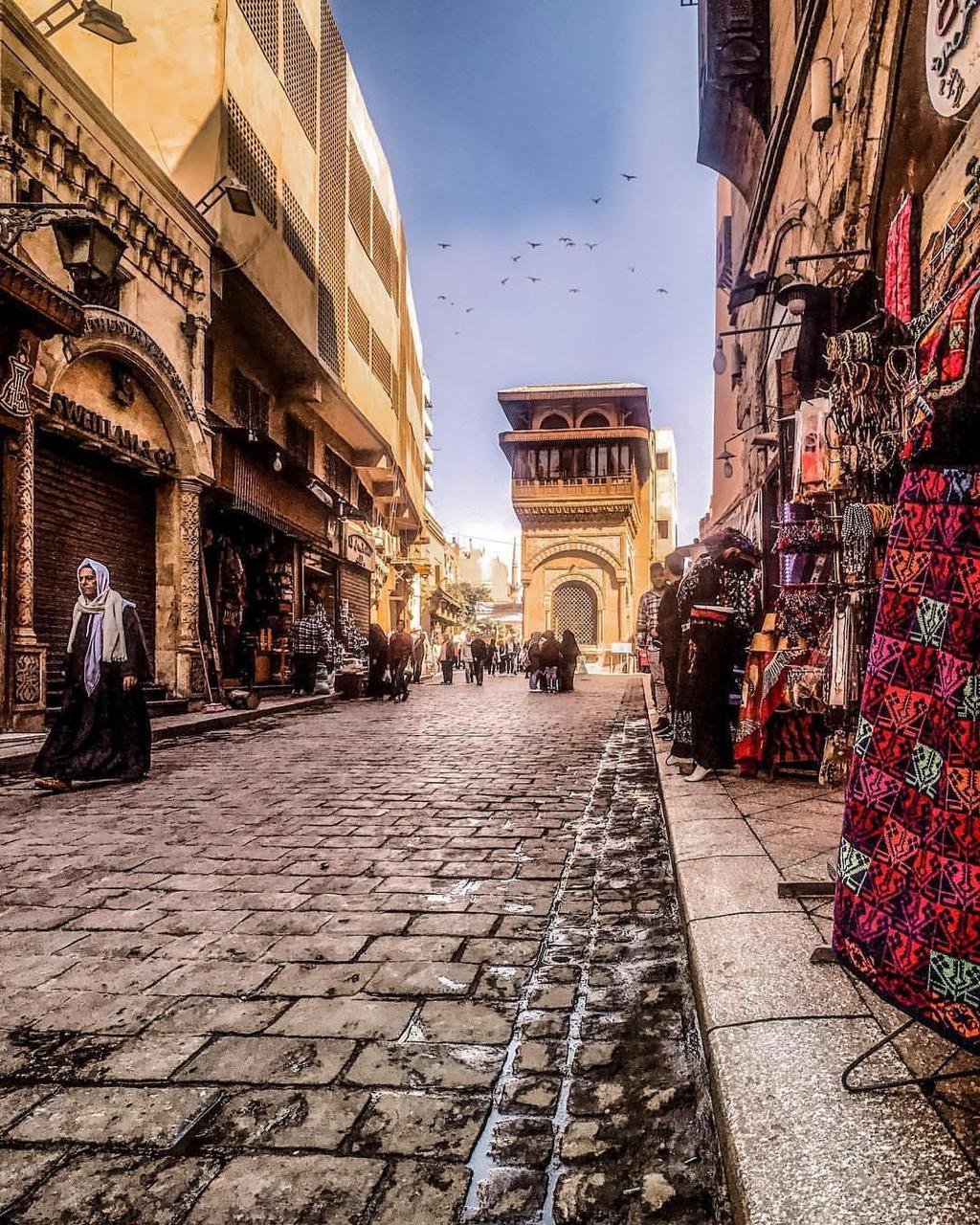
When travelers ask exactly what is in Cairo beyond the ancient pharaonic monuments and the colossal Pyramids of Giza, the answer lies in its vibrant, labyrinthine medieval heart. Long before modern skyscrapers lined the Nile, the city was a glittering epicenter of empires. Welcome to Islamic Cairo, a UNESCO World Heritage site and an open-air museum of Islamic architecture, history, and culture.
Stepping into Islamic Cairo Egypt is like stepping into a time machine. The air is thick with the scent of cardamom, roasting nuts, and aged incense. The skyline is pierced by a forest of intricately carved minarets, earning Cairo its famous moniker: “The City of a Thousand Minarets.” Here, history isn’t locked behind glass displays; it is lived, breathed, and walked upon every single day.
Whether you are seeking a stunning tourist spot in Cairo Egypt or aiming to lose yourself in atmospheric alleys, this comprehensive guide will walk you through the ultimate sights in Old Cairo. From navigating bustling bazaars to understanding architectural marvels, we will uncover the hidden cultural treasures of Islamic Cairo. 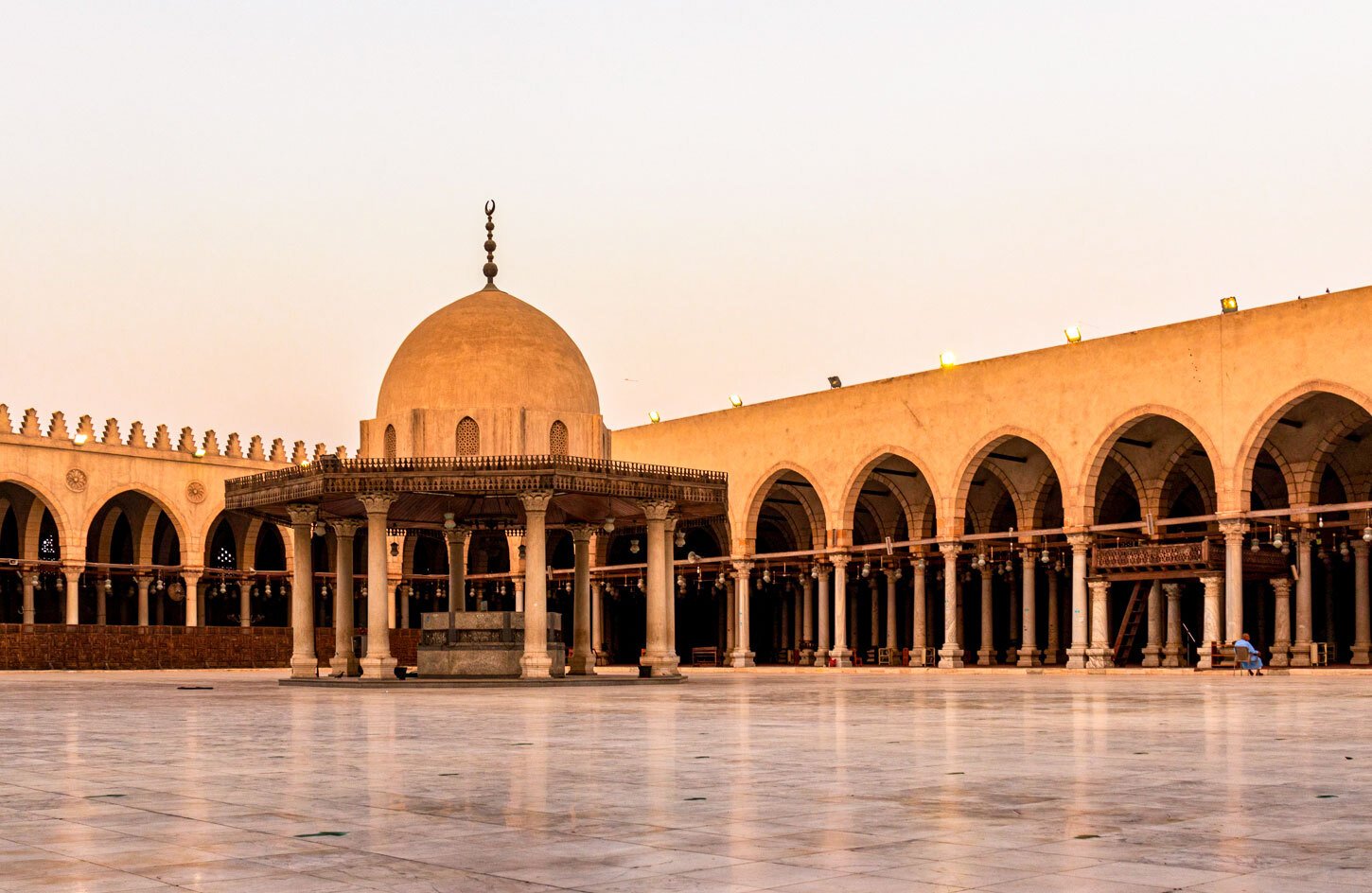
The Historical Tapestry of Islamic Cairo
To truly appreciate the breathtaking sites in Islamic Cairo, you must first understand the empires that built them. Islamic Cairo—often referred to as Historic Cairo or Old Cairo—was not built in a day. It is the layered result of successive Islamic dynasties, each leaving its indelible mark on the city’s architectural canvas.
Fatimid Caliphate Landmarks and History
The story of the city as we know it begins with the Fatimid Caliphate landmarks and history. In 969 AD, the Fatimids, a Shia Islamic caliphate originating from North Africa, conquered Egypt. Their general, Jawhar al-Siqilli, founded a new royal enclosure north of the existing settlements and named it Al-Qahira (The Victorious), which is the origin of the modern name, Cairo.
The Fatimids were great patrons of the arts and architecture. They enclosed their new capital with massive stone walls and monumental gates, some of which still stand today. They also established majestic mosques that doubled as centers of learning. Their architectural style favored heavy, keel-shaped arches, intricate stucco carvings, and beautiful Kufic calligraphy.
The Ayyubid, Mamluk, and Ottoman Eras
Following the Fatimids came the Ayyubids, led by the legendary Salah El-Din (Saladin), who restored Sunni Islam to Egypt and fortified the city against Crusader threats. However, it was the subsequent Mamluk dynasty (1250–1517 AD) that truly transformed the Cairo skyline.
The Mamluks, originally a military caste of formerly enslaved soldiers, became prolific builders. They constructed massive complexes featuring mosques, madrasas (schools), mausoleums, and sabils (public water fountains). Their architecture is famed for its towering minarets, striped stone facades (ablaq), and spectacular stone domes carved with geometric or floral patterns. Later, the Ottoman Empire conquered Egypt in 1517, adding elegant pencil-shaped minarets and intricate interior tilework to the city’s growing collection of landmarks. 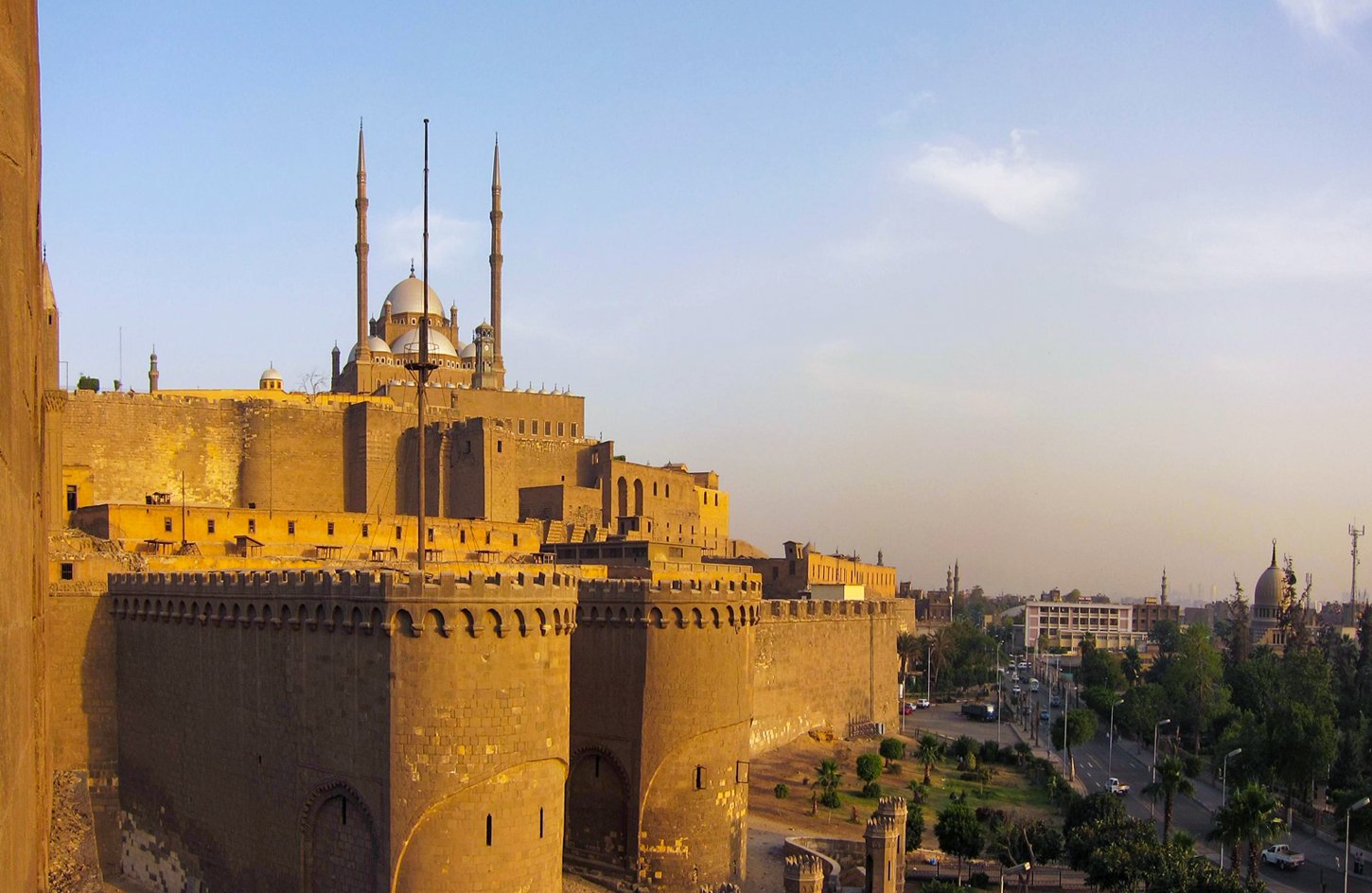
The Mighty Fortress: The Saladin Citadel
Any exploration of Islamic Cairo landmarks must begin at the city’s highest vantage point. Perched on the Mokattam Hills, the Citadel commands breathtaking views over the sprawling metropolis.
History of Saladin Citadel Fortifications
The history of Saladin Citadel fortifications is a tale of military genius and imperial power. Commissioned by Salah El-Din in 1176 to protect Cairo from the Crusaders, the fortress was strategically designed. Saladin’s engineers incorporated advanced medieval military architecture, including massive cylindrical towers, deep moats, and hidden defensive passages. For nearly 700 years, from the 13th to the 19th centuries, the Citadel served as the seat of the Egyptian government.
As you walk through the Citadel’s imposing stone gates today, you are walking in the footsteps of sultans, viziers, and conquering armies. Over the centuries, successive rulers added their own palaces and mosques within the defensive walls.
What to See Inside the Citadel
-
- The Mosque of Muhammad Ali: Also known as the Alabaster Mosque, this massive 19th-century Ottoman structure dominates the Citadel. Its twin pencil minarets are visible from almost anywhere in Cairo.
-
- The Mosque of Al-Nasir Muhammad: A stunning 14th-century Mamluk mosque featuring unique minarets adorned with green Persian tiles.
-
- The National Military Museum: Located in the former Harem Palace, it details Egypt’s military history.
-
- The Citadel Terraces: The best place for panoramic views. On a clear day, you can see all the way to the Pyramids of Giza.
A Tale of Two Mosques: Sultan Hassan and Al-Rifa’i
Just below the Citadel, at Salah El-Din Square, sit two massive religious structures facing each other. At first glance, they look like they were built by the same architect at the same time. However, they are separated by over 500 years of history. Understanding the Sultan Hassan vs Al-Rifa’i Mosque architectural differences is a fascinating study in Cairo’s evolving aesthetic. 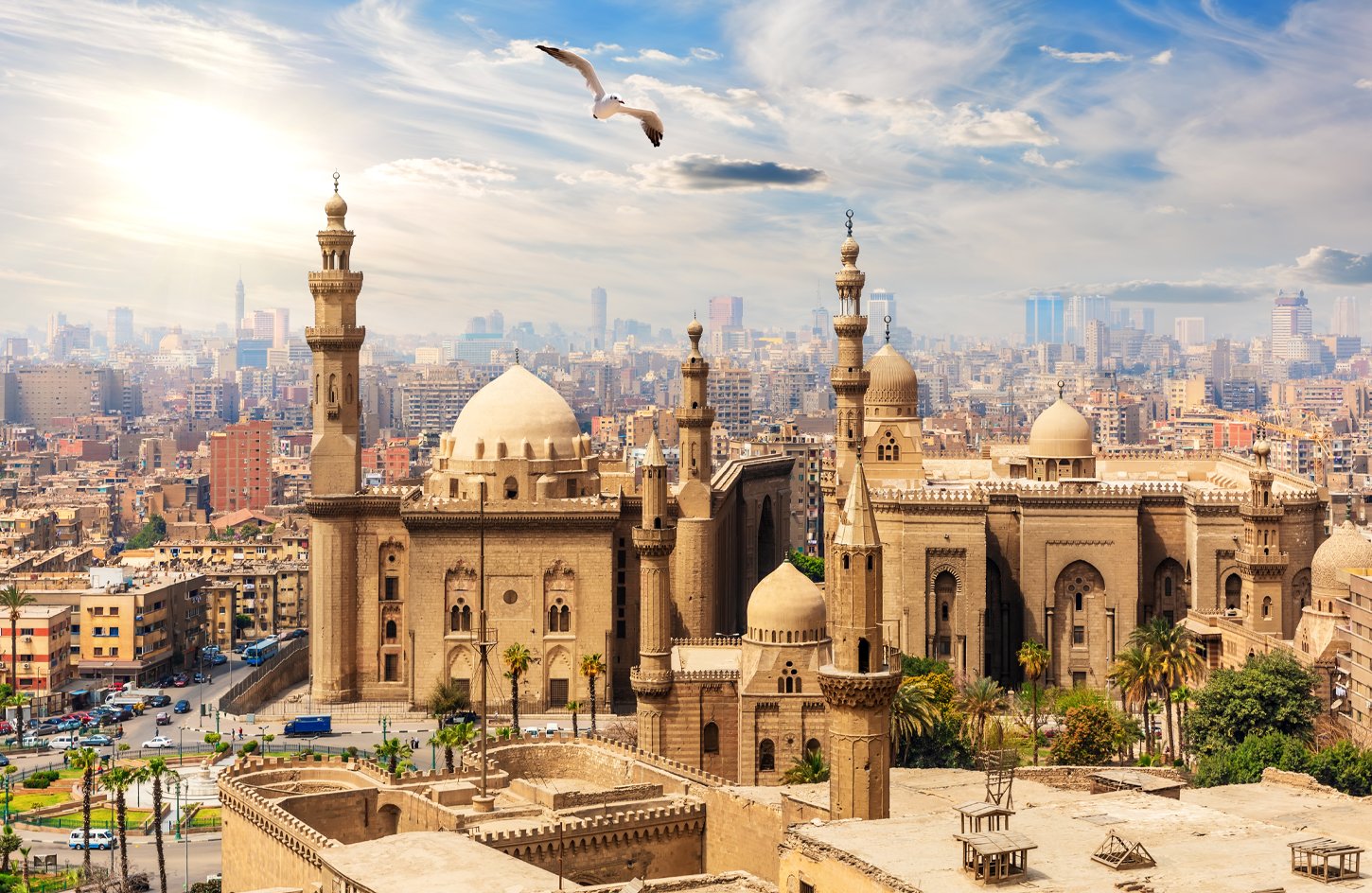
The Mosque-Madrasa of Sultan Hassan
Built between 1356 and 1363 during the Mamluk era, the Mosque of Sultan Hassan is widely considered one of the finest pieces of early Islamic architecture in the world.
-
- Scale and Grandeur: The sheer size of the building is overwhelming. It was designed to showcase the immense power and wealth of the Mamluk Sultanate.
-
- Architectural Features: It features a massive central courtyard surrounded by four soaring iwans (vaulted halls), each dedicated to teaching one of the four Sunni schools of Islamic jurisprudence.
-
- Details: Look for the magnificent bronze doors inlaid with silver and gold, the intricate marble panels on the qibla wall (indicating the direction of Mecca), and the spectacular muqarnas (stalactite vaulting) over the main portal.
Al-Rifa’i Mosque
Right next door is Al-Rifa’i Mosque. Although it mimics the Mamluk style of its older neighbor to ensure visual harmony, it was actually constructed much later, completed in 1912.
-
- The Neo-Mamluk Style: Al-Rifa’i represents a 19th/20th-century revival of Islamic architecture. While Sultan Hassan feels cavernous, stark, and awe-inspiring, Al-Rifa’i feels ornate, delicate, and lavish.
-
- Royal Mausoleum: The interior of Al-Rifa’i is breathtakingly decorated with imported European marbles, gilded ceilings, and massive crystal chandeliers. It serves as a royal mausoleum, housing the tombs of several members of the Egyptian royal family, including King Farouk, as well as the last Shah of Iran, Mohammad Reza Pahlavi.
The Key Differences: When comparing Sultan Hassan vs Al-Rifa’i Mosque architectural differences, think of Sultan Hassan as an original, robust medieval masterpiece designed for education and prayer, while Al-Rifa’i is a modern, highly decorated royal tribute built to echo the glories of the past.
Al-Azhar Mosque: The Beacon of Islamic Learning
No list of sights in Cairo is complete without Al-Azhar Mosque. Founded by the Fatimids in 970 AD, it was the first mosque established in the newly founded city of Al-Qahira. Shortly after its construction, it became an educational institution, and today, Al-Azhar University is recognized as the world’s second-oldest continuously operating university and the foremost center of Sunni Islamic theology.
Walking into the gleaming white marble courtyard of Al-Azhar offers a profound sense of peace, a stark contrast to the chaotic traffic just outside its walls. You will see students from all over the world sitting on the carpeted floors, studying ancient texts in the shade of the arcades. 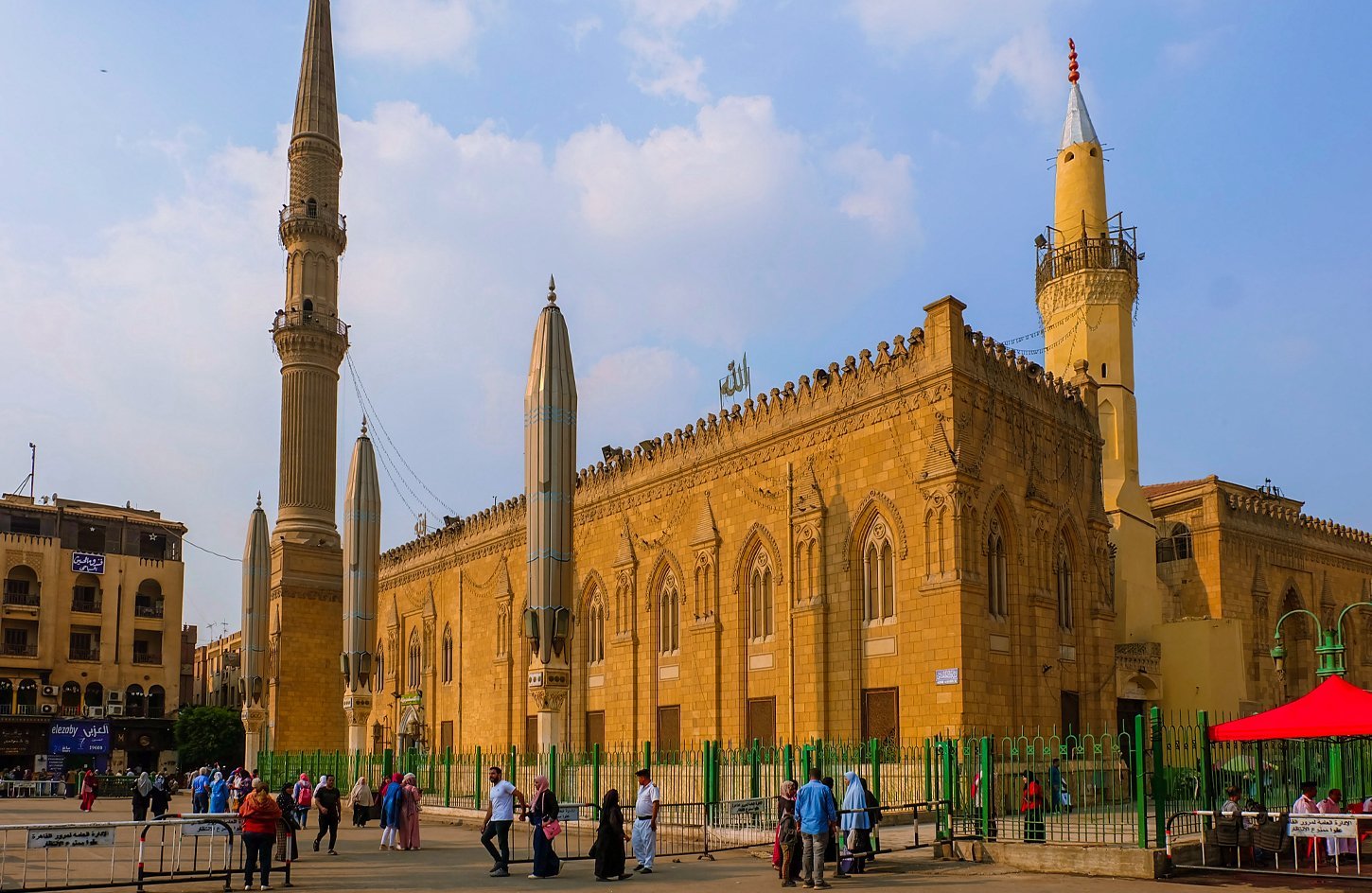
Photography Tips for Al-Azhar Mosque
Because of its pristine beauty, Al-Azhar is a photographer’s dream. Here are some essential photography tips for Al-Azhar Mosque:
-
- Timing is Everything: The best lighting occurs during the “golden hours”—early morning just after opening, or late afternoon before the Maghrib (sunset) prayer. The low sun casts beautiful shadows across the marble floors and illuminates the intricate stucco carvings of the arcades.
-
- Capture the Reflections: The white marble floor of the main courtyard is highly polished. If you get low to the ground, you can capture stunning reflections of the five distinct minarets, which represent different architectural eras (Fatimid, Mamluk, and Ottoman).
-
- Use a Wide-Angle Lens: To capture the vastness of the courtyard and the towering minarets in a single frame, a wide-angle lens (16mm-24mm) is highly recommended.
-
- Respect Worshippers: Always remember that this is an active place of worship and study. Never photograph people while they are praying, and politely ask for permission before taking close-up portraits of students or scholars. Avoid using flash inside the prayer halls.
The Heart of Medieval Cairo: Exploring Al-Muizz Street
If you only have time for one immersive experience in Islamic Cairo, it must be Al-Muizz Street (Al-Muizz li-Din Allah al-Fatimi Street). Stretching for about one kilometer, this pedestrianized street holds the highest concentration of medieval architectural treasures in the Islamic world.
The Ultimate Al-Muizz Street Walking Tour Guide
To fully experience this area, a structured approach is best. Here is your step-by-step Al-Muizz Street walking tour guide, starting from the north and making your way south.
1. Start at the Northern Gates Begin your walk at Bab al-Futuh (Gate of Conquests) and Bab al-Nasr (Gate of Victory). These massive, fortified stone gates were built in 1087 AD as part of the Fatimid city walls. Step through Bab al-Futuh, and you will instantly leave the modern world behind.
2. Al-Hakim Mosque Immediately inside the gate lies the Mosque of Al-Hakim bi-Amr Allah. Completed in 1013 AD, this colossal Fatimid mosque features a massive open courtyard and two unique, fortress-like minarets. It’s a peaceful spot to catch your breath before heading into the busier sections of the street.
3. Bayt Al-Suhaymi Take a slight detour down a narrow alley (Darb al-Asfar) to find Bayt Al-Suhaymi, a beautifully restored 17th-century Ottoman merchant’s house. It is one of the best hidden gems in Medieval Cairo neighborhoods, showcasing exquisite mashrabiya (wooden lattice windows), marble fountains, and an idyllic interior courtyard.
4. Al-Aqmar Mosque Continuing south on Al-Muizz, you will encounter the small but incredibly significant Al-Aqmar Mosque (The Moonlit Mosque). Built in 1125 AD, it is famous for being the first mosque in Cairo to have a decorated stone facade and the first to align its facade with the street alignment rather than facing Mecca (the interior prayer hall is angled correctly).
5. The Qalawun Complex As the street widens, you enter the Bayn al-Qasrayn (Between the Two Palaces) district. Here stands the monumental Qalawun Complex, built by the Mamluk Sultan Al-Mansur Qalawun in 1285. It includes a mosque, a madrasa, and a massive maristan (hospital). The mausoleum within this complex is often called the “Taj Mahal of the Middle East” due to its spectacular stained glass, carved stucco, and soaring dome.
6. The Mosque-Madrasa of Sultan Barquq Right next to Qalawun is the complex of Sultan Barquq, recognizable by its striking black-and-white marble portal and magnificent bronze-plated doors. The interior courtyard is an oasis of calm.
As you walk this route, take time to browse the small silver shops, antique dealers, and spice vendors that line the street. The area becomes beautifully illuminated at night, making an evening stroll highly recommended. 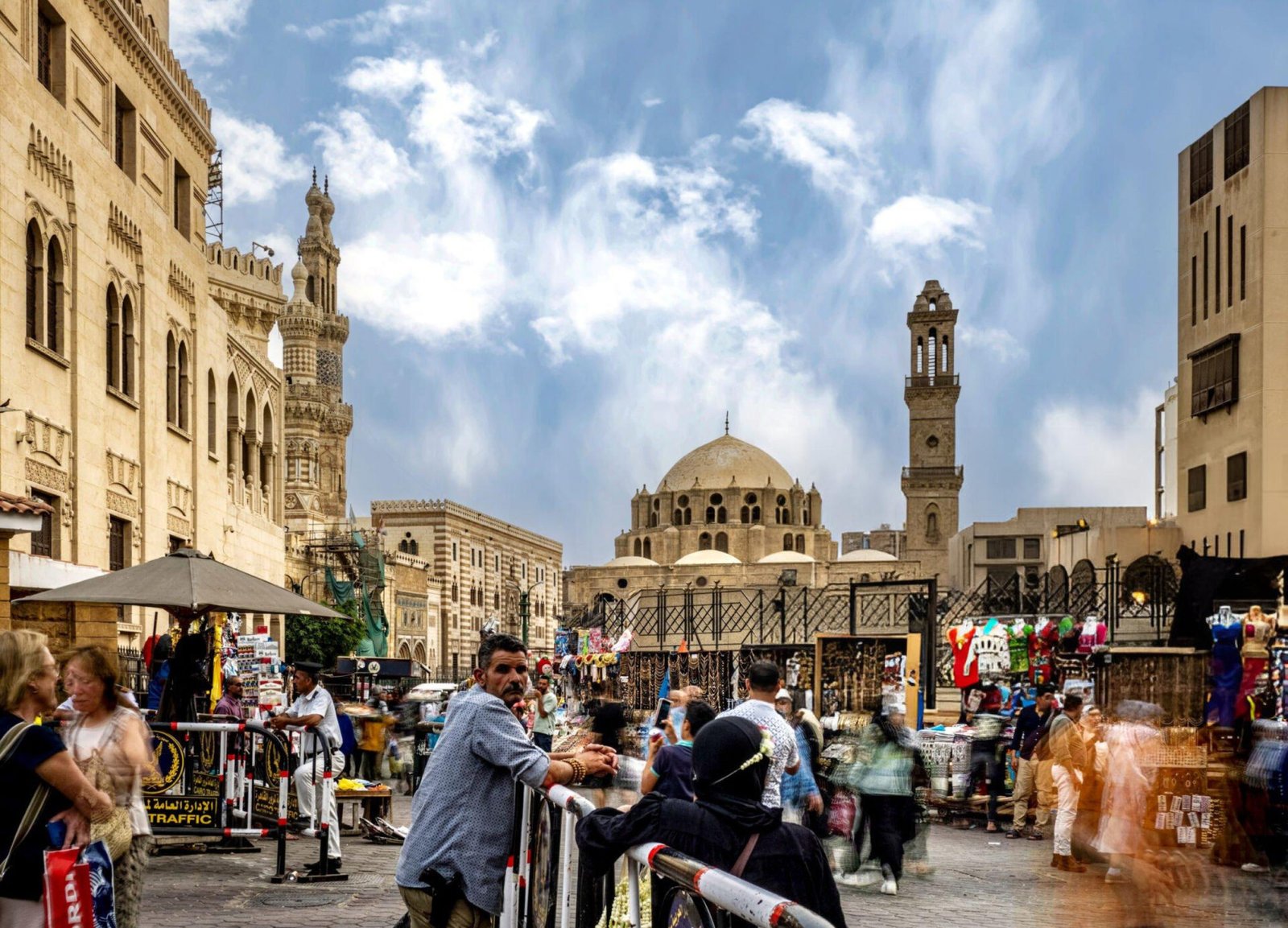
Into the Southern Quarters: Darb El Ahmar & Bab Zuweila
While many tourists stop their Al-Muizz walk at the main road (Al-Azhar Street), crossing over into the southern extension of Islamic Cairo is highly rewarding.
How to Reach Bab Zuweila Gate
To continue your journey, cross Al-Azhar Street and continue south along the street of Al-Ghouriya, a bustling market area famed for textiles and clothing. Keep walking straight for about 10-15 minutes, navigating through the colorful displays of fabrics, and you will soon see the massive wooden doors and twin minarets of Bab Zuweila.
Bab Zuweila is the last remaining southern gate of the original Fatimid city walls, built in 1092. Historically, it was a place of public executions, and the heads of criminals (and occasionally rival sultans) were displayed here. Today, it offers one of the best interactive experiences in the city. For a small fee, you can climb the steep, winding stone stairs all the way to the top of the twin minarets. The panoramic view over the rooftops of Historic Cairo is unparalleled.
Mamluk Era Monuments in El Darb El Ahmar
Exiting out of Bab Zuweila, you enter the historic working-class neighborhood of El Darb El Ahmar. Thanks to extensive restoration work by the Aga Khan Trust for Culture over the past two decades, this area has been revitalized. It is packed with Mamluk era monuments in El Darb El Ahmar that receive a fraction of the tourists compared to Al-Muizz street.
-
- Mosque of Amir al-Maridani: A short walk from Bab Zuweila, this 14th-century mosque boasts a unique octagonal minaret and stunning wooden mashrabiya screens that separate the main prayer area from the courtyard.
-
- The Blue Mosque (Aqsunqur Mosque): Further down the street, this mosque is famous for the beautiful blue Iznik tiles that decorate its qibla wall, added during the Ottoman era by Ibrahim Agha.
-
- Al-Azhar Park: While not an ancient monument, this stunning 74-acre park borders Darb El Ahmar. Created from a centuries-old rubble dump, it is now Cairo’s most beautiful green space, offering sweeping views of the Citadel and the Mamluk City of the Dead.
Sensory Overload: The Historic Bazaars
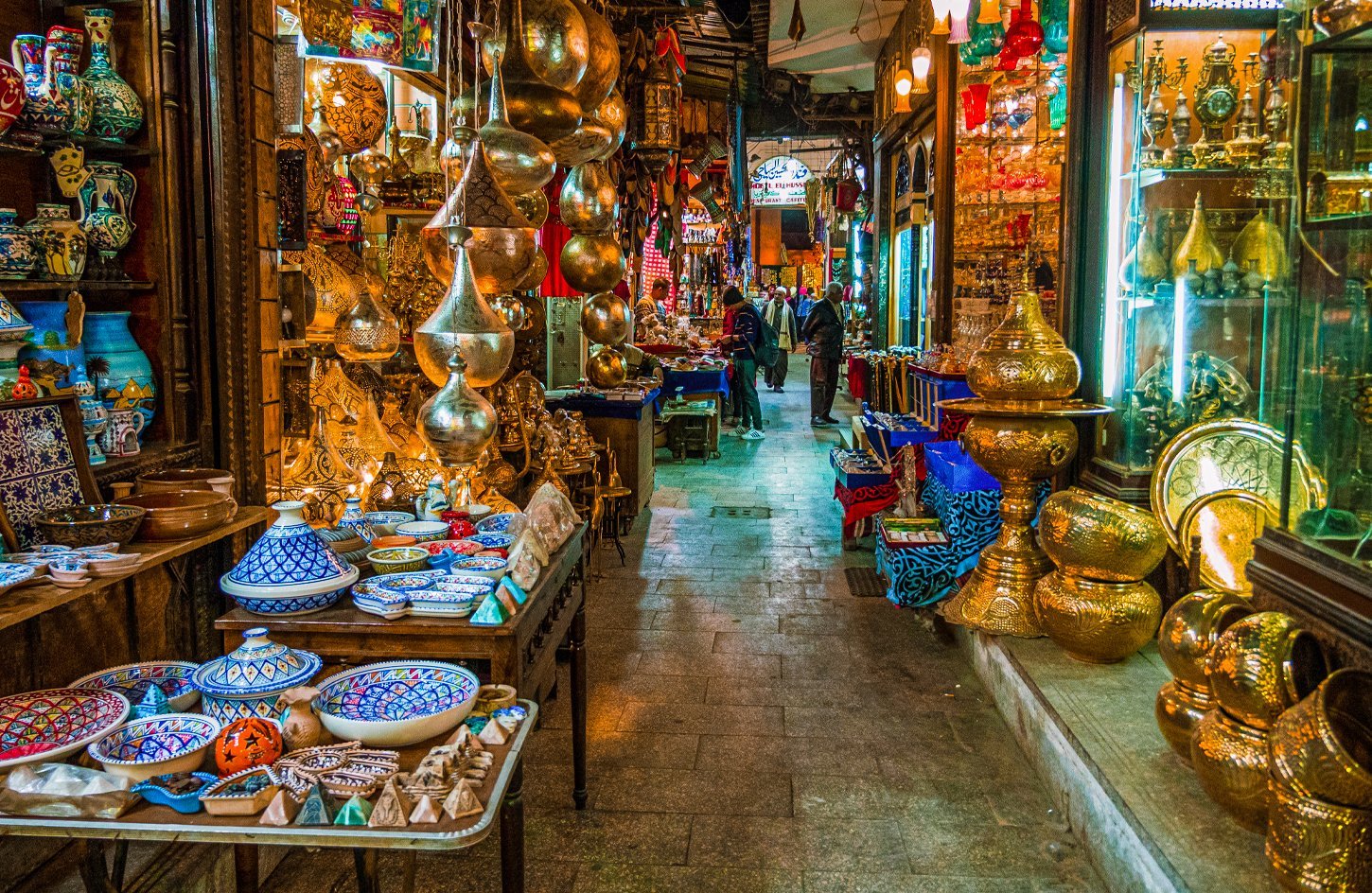
No visit to Islamic Cairo is complete without engaging in the ancient tradition of commerce. The bazaars (souqs) of Cairo are legendary, offering a sensory overload of sights, sounds, and smells.
The Famous Khan el-Khalili
Established in the 14th century as a caravanserai (a roadside inn for traveling merchants), Khan el-Khalili is the most famous market in Egypt and a premier tourist spot in Cairo Egypt. Today, its winding, maze-like alleys are packed with vendors selling everything from intricate brass lanterns and glowing alabaster statues to aromatic spices, essential oils, and colorful textiles.
Best Time to Visit Khan el-Khalili Bazaar:
-
- For Shopping and Photography: The best time to visit Khan el-Khalili bazaar for serious shopping or photography is in the early morning (around 9:30 AM to 11:00 AM). The merchants are just opening up, the light is soft, and you can browse the alleys without the crushing crowds.
-
- For Atmosphere: To truly experience the magic of the market, you must return in the evening. After sunset, the lanterns are lit, the cafes fill up with locals smoking shisha (water pipes), and the air buzzes with energy. Grab a mint tea at the famous Fishawawi Cafe (Café el-Fishawy), which has been open continuously for over 200 years.
Walking Route from Al-Azhar to Khan el-Khalili
Because the area is dense, visitors sometimes get disoriented. The walking route from Al-Azhar to Khan el-Khalili is actually very straightforward.
-
- Exit the main gates of Al-Azhar Mosque.
-
- Directly in front of you is the busy Al-Azhar Street. Do not attempt to run across the traffic.
-
- Look for the pedestrian underpass (tunnel) located just a few meters to your right.
-
- Walk through the tunnel. When you emerge on the other side, you will be in a small square (Midan Al-Hussein).
-
- To your right is the majestic Al-Hussein Mosque. Directly in front of you and to your left are the labyrinthine entrances to Khan el-Khalili.
Traditional Egyptian Crafts in the Tentmakers Market
If you want to escape the tourist-focused trinkets of Khan el-Khalili and see genuine artisans at work, head south of Bab Zuweila to the Street of the Tentmakers (Sharia al-Khayamiya).
This covered market is the last remaining authentic medieval craft market in Cairo. Here, you will find the traditional Egyptian crafts in the Tentmakers Market. Artisans sit cross-legged in small stalls, painstakingly hand-stitching intricate geometric and floral designs onto heavy canvas.
Historically, these craftsmen created the massive, colorful appliqué tents used for royal ceremonies and desert caravans. Today, they create stunning wall hangings, cushion covers, and bedspreads. The work is mesmerizing to watch, the quality is exceptional, and buying a piece here directly supports a centuries-old heritage craft that is slowly disappearing.
Venturing Off the Beaten Path
Beyond the main thoroughfares, Islamic Cairo hides numerous treasures that reward the intrepid traveler. Exploring the hidden gems in Medieval Cairo neighborhoods provides a deeper connection to the city’s soul.
The Gayer-Anderson Museum
Located right next to the Mosque of Ibn Tulun, the Gayer-Anderson Museum is a spectacular example of domestic Islamic architecture. Formed by joining two 16th and 17th-century merchants’ houses, it was restored by a British military officer, Major John Gayer-Anderson, in the 1930s. The house is filled with his eclectic collection of Islamic art, furniture, and antiquities. The intricate wooden balconies, secret hidden corridors, and rooftop terraces (featured in the James Bond film The Spy Who Loved Me) make it an absolute must-visit.
Wekalet El Ghouri and the Whirling Dervishes
A wekala is a medieval merchants’ inn. Wekalet El Ghouri, near Al-Azhar Street, is a beautifully preserved 16th-century complex. While the architecture alone is worth a visit, the real draw is the cultural performance. Several nights a week, the courtyard hosts the Al-Tannoura Egyptian Heritage Dance Troupe. Unlike the solemn, meditative whirling dervishes of Turkey, the Egyptian Tannoura is a vibrant, colorful, and highly energetic spectacle set to live, thumping Sufi music.
Practical Guide for Exploring Islamic Cairo
Navigating the historic quarters of Cairo can be incredibly rewarding, but it does require some preparation. Here is everything you need to know to make your visit smooth and enjoyable.
Skip the Hassle: Explore with Cairo Day Tours
Navigating the bustling labyrinth of these historic districts, haggling with merchants, and piecing together centuries of history on your own can quickly become overwhelming. If you want to dive straight into the magic without the stress of planning logistics and where would you take lunch, skip the hassle and book the Old Cairo (Islamic and Coptic) tour with us at Easy Transfer 24/7.
Our expert local guides will seamlessly walk you through the winding alleys of the bazaar, decode the architectural marvels of Islamic Cairo, and transport you safely to the ancient, atmospheric sanctuaries of Coptic Cairo. We handle the notorious Cairo traffic, the tickets, and the timeline — leaving you free to simply soak in the incredible atmosphere and snap the perfect photos. Head over to Day Tours page to secure your spot and let us show you the true, beating heart of Egypt.
Current Entrance Fees for Cairo Historic Sites
Egypt’s Ministry of Tourism and Antiquities periodically updates ticket prices, so while exact figures can fluctuate, you should be prepared. Generally, the current entrance fees for Cairo historic sites are quite affordable compared to European attractions.
-
- The Saladin Citadel: Usually around 500- 550 EGP (Egyptian Pounds) for foreign adults.
-
- Sultan Hassan & Al-Rifa’i Mosques: A combined ticket is typically around 120 – 150 EGP.
-
- Mosque of Ibn Tulun & Al-Azhar Mosque: Free to enter, though a small tip (baksheesh) to the shoe-keeper is customary (10-20 EGP).
-
- Climbing Bab Zuweila Minarets: Around 80 – 100 EGP.
Cultural Etiquette for Visiting Egyptian Mosques
Islamic Cairo is a living, breathing religious center. Understanding the cultural etiquette for visiting Egyptian mosques is vital to showing respect and avoiding awkward situations.
-
- Shoe Removal: You must remove your shoes before stepping onto the carpets of any mosque. Usually, there is a shoe rack at the entrance, or an attendant will hold them for a small tip. Alternatively, you can carry them in your backpack or in a plastic bag.
-
- Prayer Times: Avoid visiting non-tourist mosques during the five daily prayer times, particularly the midday Friday prayer (Jumu’ah), which is the most important and crowded service of the week.
-
- Behavior: Speak softly. Do not walk directly in front of someone who is praying. Refrain from public displays of affection.
What to Wear When Visiting Religious Sites in Cairo
Dressing appropriately is not just about following rules; it is about blending in and showing respect to the local culture. When considering what to wear when visiting religious sites in Cairo, modesty is key for both men and women.
-
- For Women: Shoulders, chests, and knees must be covered. Loose-fitting maxi dresses, long skirts, or wide-leg trousers paired with long-sleeved, opaque blouses are ideal. You will also need to cover your hair when entering active mosques, so always carry a lightweight pashmina or scarf in your day bag. If you are deemed dressed inappropriately, some major mosques (like Al-Azhar) will provide a hooded robe for you to wear during your visit.
-
- For Men: Men should avoid wearing shorts or sleeveless shirts. Long trousers (jeans, chinos, or linen pants) and a t-shirt or button-down shirt are appropriate.
-
- Footwear: Since you will be taking your shoes off frequently and walking on dusty, uneven cobblestone streets, wear comfortable, slip-on walking shoes or sturdy sandals. Bring a pair of socks if you prefer not to walk barefoot on the mosque carpets.
Safety Advice for Solo Travelers in Old Cairo
Cairo is generally a very safe city, and violent crime against tourists is exceedingly rare. However, the chaotic environment of Islamic Cairo requires some street smarts. Here is some practical safety advice for solo travelers in Old Cairo:
-
- Navigating Traffic: Crossing the street in Cairo is an art form. Traffic rarely stops for pedestrians. The trick is to walk at a steady, predictable pace, making eye contact with drivers, and letting the cars weave around you. If you are nervous, stand next to a local and cross when they cross.
-
- The “Helpful Local” Scam: While many Egyptians are genuinely hospitable, be wary of overly friendly strangers who approach you in tourist areas telling you a street is “closed for prayer” or offering to show you a “special government market.” This is almost always a ploy to lead you to their family’s perfume or papyrus shop where you will be pressured to buy. A polite but firm “La shukran” (No thank you) and walking away is the best approach.
-
- Secure Your Belongings: The crowded bazaars of Khan el-Khalili and Al-Ghouriya are prime spots for pickpockets. Wear a crossbody bag, keep your wallet in your front pocket, and be mindful of your camera gear in tight crowds.
-
- Getting Around: Navigating the labyrinth can be confusing. Download offline maps on your smartphone before you head out. Ride-sharing apps like Uber and Careem are the safest, cheapest, and easiest ways to get to and from the borders of Islamic Cairo without having to haggle with taxi drivers over fares.
-
- Stay Hydrated: Cairo is hot and dusty for most of the year. Always carry bottled water with you, and avoid drinking tap water.
Tasting the Local Flavors
A journey through Islamic Cairo is also a culinary adventure. As you explore the Cairo landmarks, you will burn a lot of energy. Skip the international fast food and dive into traditional Egyptian street food.
-
- Koshary: Egypt’s national dish is a hearty, vegan-friendly mix of macaroni, rice, lentils, and chickpeas, topped with a spicy tomato sauce and crispy fried onions. It is cheap, filling, and delicious.
-
- Hawawshi: Minced meat mixed with onions and spices, stuffed into a pita bread, and baked in a wood-fired oven until crispy. You can smell it wafting through the alleys of Darb El Ahmar.
-
- Fresh Juices: Dotted around the souqs are juice stands displaying hanging fruits. Order a cold, freshly squeezed mango juice or asab (sugarcane juice) for a refreshing sugar boost.
Conclusion
Exploring Islamic Cairo is not a passive experience; it demands your participation. It requires you to navigate the chaotic traffic, to haggle with the spice merchants, to tilt your head back to marvel at soaring Mamluk domes, and to pause and listen as the call to prayer echoes from a thousand minarets.
From the sweeping history of Saladin Citadel fortifications to the tranquil marble courtyards of Al-Azhar, and from the neon-lit energy of Khan el-Khalili to the quiet, rhythmic stitching in the Tentmakers Market, this historic district offers a profound cultural immersion.
If you have ever wondered what is in Cairo beyond the ancient pharaohs, the answer is a vibrant, enduring medieval civilization. By wandering through these historic streets, respecting the cultural etiquette, and taking the time to uncover the hidden gems, you will discover the true, beating heart of Egypt. Pack your walking shoes, charge your camera, and get ready to lose yourself in the magic of Islamic Cairo.
Check out our other articles:
- Ancient Egypt: Unveiling Mysteries & Culture
- Touristic Sights Visited by the Holy Family in Egypt
- Most Famous Egypt Tour Packages