
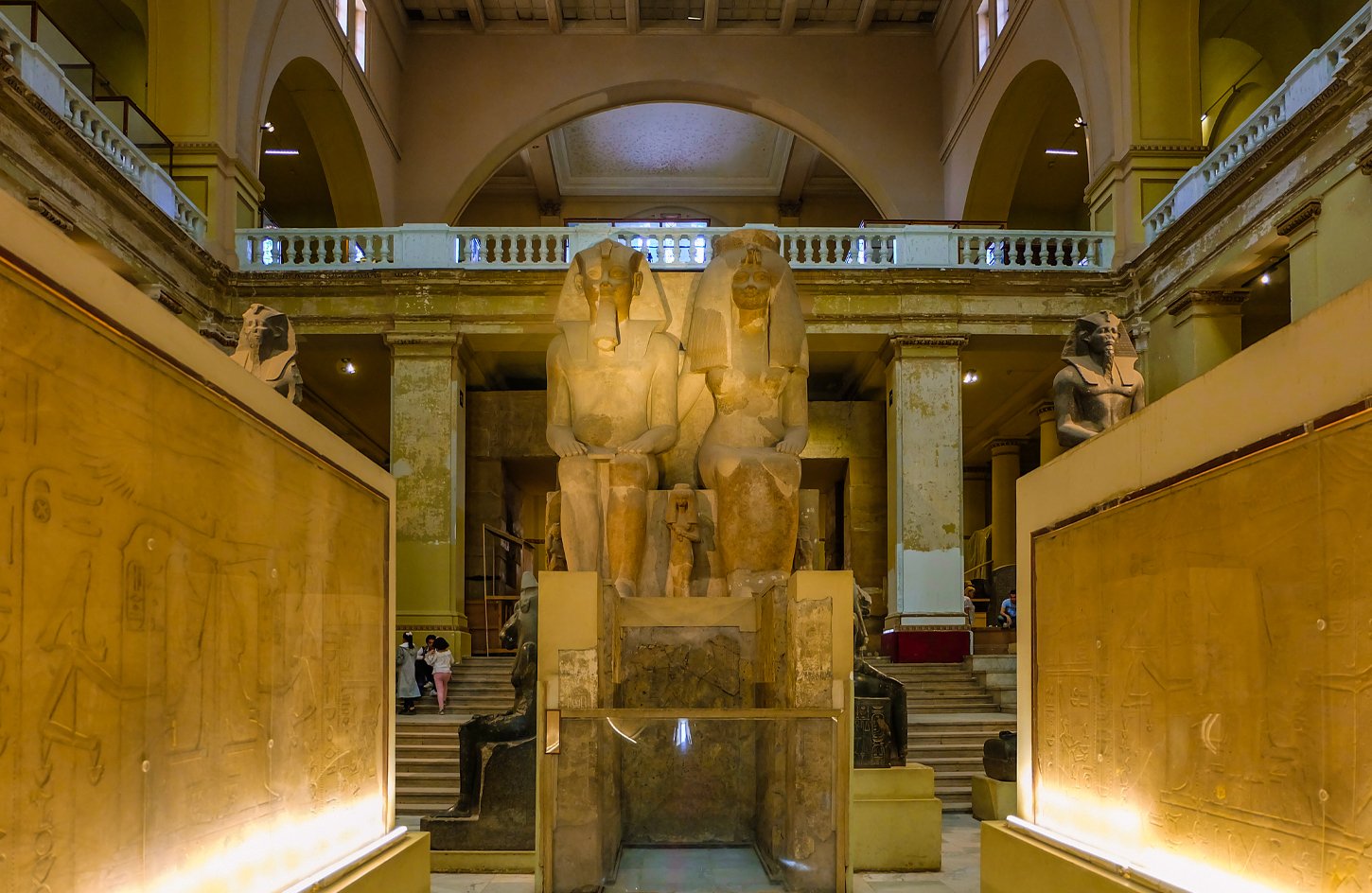
Introduction
The New Era of Egyptian Museums
For over a century, a trip to see the antiquities of Egypt meant bracing yourself for the chaotic, dusty, and heavily crowded halls of a single building in downtown Cairo. For decades, the Egyptian Museum in Tahrir Square was the undisputed heavyweight of global archaeology, acting as a massive, overflowing warehouse for the country’s most priceless treasures.
However, if you are planning a trip to Egypt in 2026, your itinerary requires a major update. The landscape of Cairo museums has completely transformed in recent years. The country has meticulously decentralized its most precious artifacts, officially ending the era of the single, overstuffed storehouse.
Egypt has ushered in a new age of cultural display, creating specialized, state-of-the-art facilities designed to tell the story of the Pharaohs with unprecedented clarity, space, and modern technology. Whether you are looking for specific cairo egypt attractions or just wondering what to see in cairo on a tight schedule, understanding this monumental shift is the single most important step in planning your trip.
The “Big Three” Explained
The days of seeing King Tutankhamun’s golden mask and the Royal Mummies in the same building are officially over. To protect these priceless antiquities and offer tourists a more immersive, logical experience, the Ministry of Tourism and Antiquities has split the crown jewels of ancient Egypt across three distinct locations—often referred to by modern travelers as the “Big Three.”
- The Grand Egyptian Museum (GEM): The massive, modern mega-complex situated on the Giza plateau, now the exclusive home to the complete King Tutankhamun collection.
- The National Museum of Egyptian Civilization (NMEC): The striking, chronologically organized facility in Fustat that now permanently houses the royal mummies of Egypt’s greatest pharaohs.
- The Egyptian Museum (Tahrir Square): The historic, original 1902 pink palace in downtown Cairo, which retains world-class Old Kingdom artifacts and offers an unmatched vintage archaeological vibe.
If you want to experience the best Cairo museums without feeling completely overwhelmed or showing up to the wrong building looking for a specific artifact, you need to know exactly what is—and what is not—inside each one.
The Grand Egyptian Museum (GEM): The Modern Mega-Museum
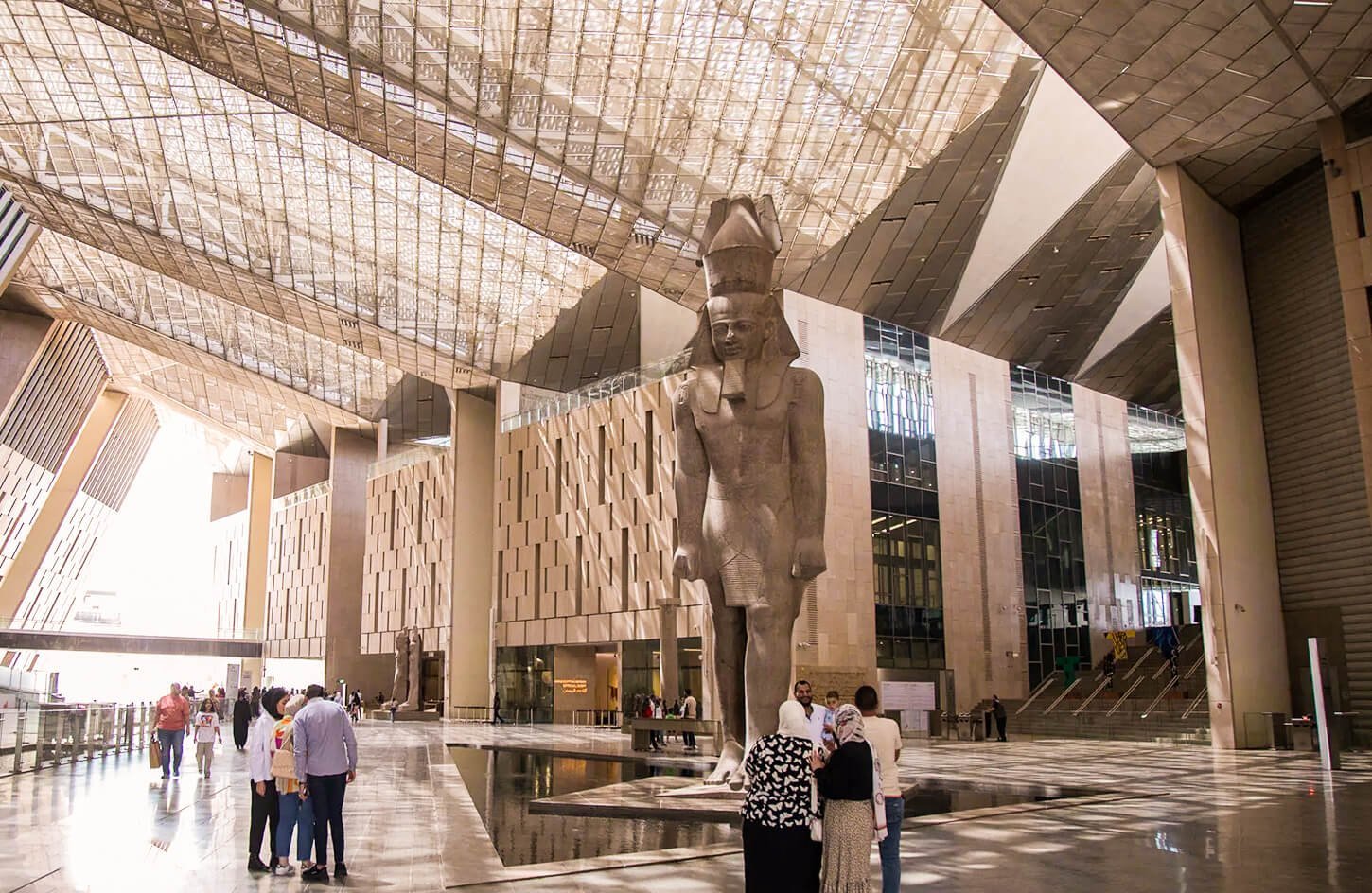
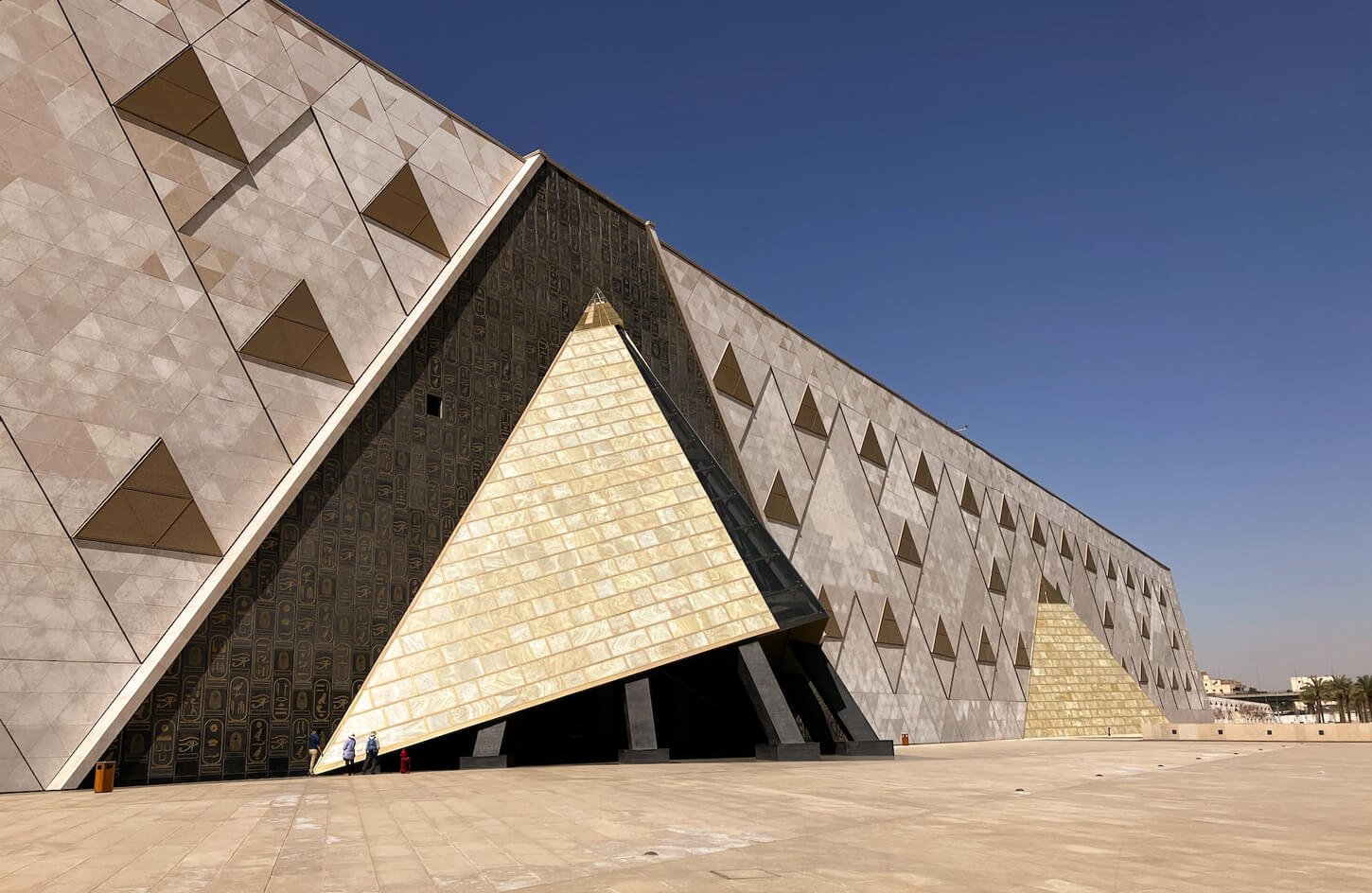
The sheer scale of the GEM is difficult to comprehend until you are standing at its gates. It completely redefines the concept of a cairo museum, moving away from dense, poorly lit corridors and instead embracing vast, open-air architecture that honors the monumental nature of the civilization it represents.
The museum’s sharp, modern lines were designed to complement, rather than compete with, the ancient wonders resting just over a mile away.
Overview & Architecture
Situated just over a mile from the Giza Pyramids, the Grand Egyptian Museum is a true architectural marvel and the undisputed crown jewel of modern cairo sightseeing places. Costing over $1 billion and taking nearly two decades from its initial architectural competition to its full realization, the GEM holds the title of the largest archaeological museum in the world dedicated entirely to a single civilization.
Designed by the architectural firm Heneghan Peng, the building itself is a masterpiece of modern engineering. Its facade features an intricate, translucent alabaster motif composed of massive triangular patterns that echo the geometric perfection of the nearby pyramids. As you walk through the monumental entrance courtyard, the sheer scale of the atrium makes you feel incredibly small—a deliberate design choice meant to mimic the awe-inspiring, imposing nature of ancient Pharaonic temples.
Unlike the older facilities of the past, the GEM utilizes cutting-edge climate control, modern fiber-optic lighting, and interactive digital displays to breathe life into the stones.
Must-See Highlights
The GEM is vast, covering nearly 5.2 million square feet of floor space. While you could easily spend days wandering its sprawling wings, your visit should prioritize three monumental exhibits:
- The Complete King Tutankhamun Collection: This is the undisputed main event. For the first time in history, all 5,000+ artifacts discovered by British archaeologist Howard Carter in 1922 are displayed together in one place. The exhibit goes far beyond his famous golden death mask and inner sarcophagus. You will see his disassembled chariots, intricate lapis lazuli jewelry, massive gilded wooden shrines, intricately carved walking sticks, and even his ancient linen undergarments. The collection is laid out logically, allowing visitors to experience the artifacts exactly as they were layered within his burial chambers in the Valley of the Kings.
- The Grand Staircase and the Colossus of Ramses II: The moment you enter the main atrium, you are greeted by an 83-ton, 36-foot-tall red granite statue of Ramses the Great. This magnificent colossus was famously moved from the congested Ramses Square in downtown Cairo to the GEM in 2018 in a highly publicized engineering feat. Behind him rises the Grand Staircase, a sweeping, multi-level gallery displaying dozens of colossal statues, heavy sarcophagi, and architectural fragments that chronologically guide you up to a stunning, panoramic glass wall overlooking the Giza Pyramids.
- Khufu’s Solar Boat: Previously housed in a rather dated, greenhouse-like museum right next to the base of the Great Pyramid, the 4,600-year-old intact cedar ship belonging to Pharaoh Khufu has been meticulously relocated. It now rests in a dedicated, state-of-the-art, climate-controlled wing of the GEM. The ship was buried in pieces to carry the pharaoh through the afterlife, and seeing its reassembled, sweeping hull is a testament to the maritime engineering of the Old Kingdom.
Best For
The GEM is essential for first-time visitors, devoted King Tut fans, and travelers looking to pair a museum day seamlessly with a tour of the Pyramids. Because of its location in Giza, it perfectly anchors the “ancient wonders” portion of any Egyptian itinerary without forcing you to cross the chaotic Nile bridges into downtown Cairo.
National Museum of Egyptian Civilization (NMEC): The Royal Resting Place
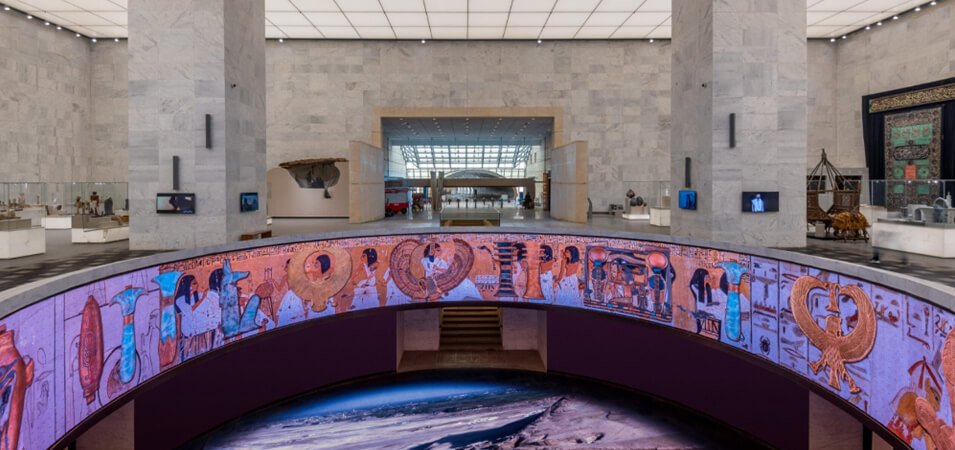
While the GEM focuses on the sheer volume of Pharaonic treasures, the NMEC takes a vastly different approach. It is a highly curated, deeply respectful space that treats its most famous residents not merely as artifacts, but as the revered monarchs they once were.
The museum’s setting provides a tranquil contrast to the bustling city, grounding the ancient history in a beautifully modern environment.
Overview & Location
If your goal is to lock eyes with the most powerful rulers of the ancient world, you must head to the National Museum of Egyptian Civilization. Located in the historic Fustat district—the first Islamic capital of Egypt, founded in 641 AD—the NMEC overlooks the beautifully revitalized Lake Ain el-Sira.
The museum captured the world’s attention in April 2021 during the spectacular “Pharaohs’ Golden Parade,” a televised event where 22 royal mummies were transported through the streets of Cairo on custom-built, shock-absorbent vehicles to their new, permanent home here.
Unlike traditional Egyptian museums that group artifacts by material (e.g., a room for stone, a room for wood), the NMEC takes a holistic, chronological approach. It walks you continuously through the dawn of Egyptian history, up through the Greco-Roman period, into the Coptic and Islamic eras, and all the way to modern times.
Must-See Highlights
Do not let outdated travel guides or old blog posts fool you; tourists often mistakenly go to Tahrir or the GEM looking for the royal mummies. They are exclusively housed here.
- The Royal Mummies Hall: This is the absolute centerpiece of the NMEC and arguably the most powerful exhibit in the country. Designed to replicate the hushed, subterranean atmosphere of the underground tombs in the Valley of the Kings, this dimly lit, circular hall houses 18 kings and 4 queens. Here, you will come face-to-face with legendary, empire-building figures like Ramses II, Queen Hatshepsut, Seti I, and the great warrior pharaoh Thutmose III. The display is incredibly respectful; photography is strictly prohibited, and the mummified remains are paired with their original coffins and modern X-ray scans detailing their health, age, and how they died.
- The Main Exhibition Hall: While the mummies rest downstairs, the vast, naturally lit ground-floor hall offers a masterclass in the continuous flow of Egyptian culture. It seamlessly transitions from prehistoric stone tools and early Pharaonic statues to exquisite Greco-Roman jewelry, beautifully preserved Coptic Christian textiles, intricate Islamic pottery, and traditional Egyptian folk art. It is a powerful reminder that Egypt’s cultural legacy did not simply vanish when the last pharaoh fell.
Best For
This museum is unparalleled for travelers who want to see the Pharaohs face-to-face and those seeking to understand the broader, continuous flow of Egyptian history beyond just the ancient era. It is a highly curated, easily digestible cairo egypt museum that takes only a few hours to explore, ensuring you won’t suffer from “artifact fatigue.”
The Egyptian Museum (Tahrir Square): The Historic Classic
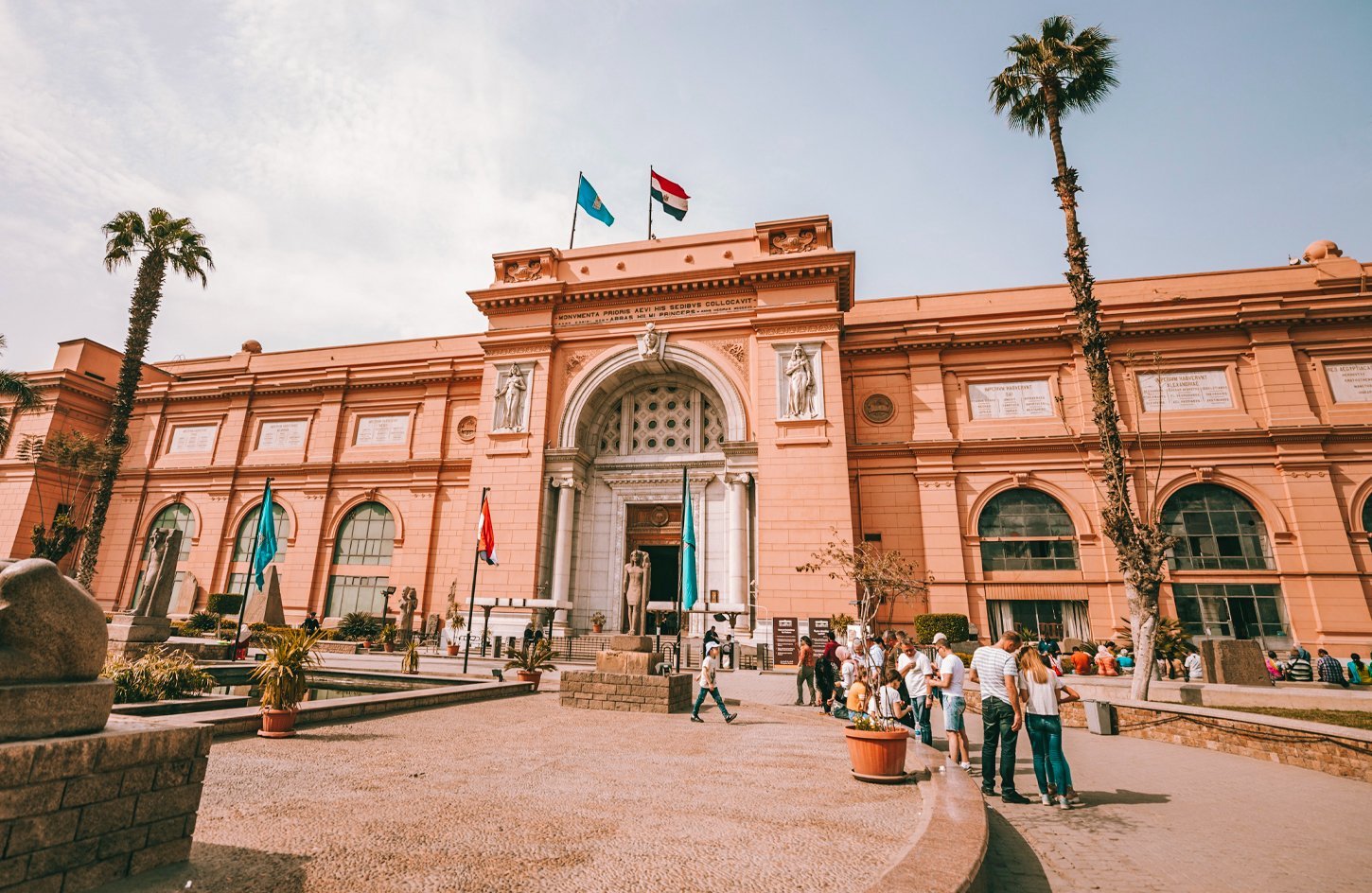
With the departure of King Tut and the Royal Mummies, many travelers wonder if the original museum in downtown Cairo is still worth visiting. The answer is a resounding yes. It has evolved from an overcrowded warehouse into a beautifully nostalgic monument to the golden age of archaeology.
The iconic red facade stands as a testament to the early days of modern Egyptology, holding its ground in the bustling center of Cairo.
Overview & Atmosphere
The Egyptian Museum in Tahrir Square—often referred to as egyptian museum cairo by travelers—is essentially a “museum of a museum.” Opened in 1902 and designed by French architect Marcel Dourgnon, this iconic pinkish-red building is a masterpiece of neo-classical architecture. Walking its halls feels like stepping directly onto a 19th-century Hollywood movie set.
It completely lacks the slick touchscreens, vast open spaces, and minimalist curation of the GEM or NMEC. Instead, it offers an atmospheric, Indiana Jones-style treasure hunt. Heavy wooden display cases, handwritten paper labels from a century ago, creaky wooden floorboards, and towering statues stacked seemingly on top of one another give it an undeniable, old-world charm. It represents the legacy of early Egyptologists like Auguste Mariette and Gaston Maspero, and wandering its halls feels like discovering the artifacts yourself.
Clearing up the Confusion
Let’s be very clear to avoid any disappointment: The King Tutankhamun collection and the Royal Mummies are NO LONGER HERE. If those are your primary reasons for seeking out cairo attractions, you must go to the GEM and the NMEC, respectively.
What Remains (Must-See Highlights)
Despite losing its two most famous, headline-grabbing exhibits, Tahrir remains an absolute powerhouse of antiquities. It still houses tens of thousands of artifacts that would be the crown jewels of any other museum in the world.
- Old Kingdom Masterpieces: The ground floor holds some of the finest, most lifelike stonework in human history. Do not miss the breathtaking diorite statue of Khafre (the builder of the second pyramid at Giza), which features the falcon god Horus wrapping its wings protectively around his head. Look for the incredibly lifelike wooden statue of Ka-Aper (whose rock-crystal eyes seem to follow you), and the remarkably preserved painted limestone statues of Prince Rahotep and his wife Nofret, whose colors remain vibrant after 4,600 years.
- The Narmer Palette: Arguably the most important historical document in Egypt, this 5,000-year-old shield-shaped stone tablet depicts the unification of Upper and Lower Egypt by King Narmer, effectively marking the very beginning of the Pharaonic civilization.
- The Fayoum Mummy Portraits: Head upstairs to see these hauntingly realistic, painted wooden portraits from the Greco-Roman period. Affixed to the faces of mummies in the Fayoum oasis, these portraits bridge the gap between ancient Egyptian burial practices and classical Roman art, offering a lifelike glimpse at the diverse faces of ancient Egyptians.
- The Treasures of Yuya and Thuya: Before Howard Carter uncovered King Tut’s tomb in the 1920s, the intact tomb of Yuya and Thuya (the great-grandparents of Tutankhamun) was the most spectacular find in the history of Egyptology. Their exquisitely gilded masks, intricately carved beds, and beautifully preserved chariots remain here in Tahrir and are absolutely spectacular.
Best For
History purists, lovers of vintage aesthetics, and travelers staying in Downtown Cairo who want to experience the romantic, dusty, golden age of early archaeology.
If you are pressed for time, choosing between these massive institutions can be the most stressful part of trip planning. Here is a quick breakdown to help you decide what fits your travel style and schedule.
Museum Showdown: Which One Should You Visit?
If you are pressed for time, choosing between these massive institutions can be the most stressful part of trip planning. Here is a quick breakdown to help you decide what fits your travel style and schedule.
The Quick Comparison
-
The Grand Egyptian Museum (GEM)
-
Location: Giza (Near Pyramids)
-
Main Attraction: King Tut’s full collection, Ramses Colossus
-
Vibe: Ultra-modern, massive, cutting-edge
-
Time Needed: 4 – 6 hours
-
-
National Museum of Egyptian Civilization (NMEC)
-
Location: Fustat (Old Cairo)
-
Main Attraction: The Royal Mummies Hall
-
Vibe: Curated, sleek, chronological
-
Time Needed: 2 – 3 hours
-
-
The Egyptian Museum (Tahrir)
-
Location: Downtown Cairo
-
Main Attraction: Old Kingdom statues, Narmer Palette
-
Vibe: Vintage, dense, archaeological romance
-
Time Needed: 2 – 4 hours
-
Itinerary Advice
- If you only have 1 day in Cairo: You have to prioritize the heavy hitters. Pair your morning visit to the Giza Pyramids with an afternoon at the GEM. This keeps you entirely on the Giza (west) side of the Nile, eliminating cross-city traffic, and lets you see the Pyramids and the complete treasures of King Tut in a single, epic day.
- If you have 2 days in Cairo: Dedicate Day 1 entirely to Giza and the GEM . On Day 2, dive into Cairo’s deeper historical layers. Start your morning at the NMEC to see the Royal Mummies before the midday crowds peak, then take a short, 15-minute drive north into Downtown Cairo to spend your afternoon soaking in the vintage charm and Old Kingdom statues of the Tahrir Museum.
Essential Logistics & Tips for 2026
Navigating a chaotic megacity of over 20 million people requires a bit of strategy. The logistics of moving between sites can easily consume your day if you aren’t prepared. Here is how to make your museum visits as seamless as possible in 2026.
Tickets & Entry
In recent years, the Egyptian Ministry of Tourism and Antiquities has heavily modernized and digitized its ticketing systems to cut down on massive entry queues.
- Advance Booking: You can, and absolutely should, book your tickets online in advance via the official egymonuments.gov.eg portal, or specifically through the GEM’s dedicated ticketing site. Advance booking is practically non-negotiable for the GEM. As the premier attraction in the country, morning time slots for the GEM frequently sell out, especially during the high season (October through April).
- Cashless Payments at the Gate: If you choose to buy tickets in person, be warned: all physical ticket counters at major Cairo museums and archaeological sites now operate entirely cashless for tourists. You must bring a physical credit or debit card (Visa or Mastercard) to tap at the kiosk. Cash (both Egyptian Pounds and foreign currency) is no longer accepted for entry tickets at the gate.
Getting Around
Cairo traffic is legendary, and the distance between these three Cairo museums is significant. Tahrir is in the urban center, NMEC is further south in the older Islamic district, and the GEM is way out west on the desert edge of the Giza plateau.
- Travel Times: Do not look at a map and assume a 10-mile distance will take 15 minutes. Driving from Tahrir Square to the GEM can take anywhere from 45 minutes to over an hour and a half depending on the time of day and traffic on the Ring Road.
- Transportation Solutions: While ride-sharing apps like Uber operate effectively in Cairo, relying on them for multi-stop, cross-city days can result in long wait times, language barriers, and spotty GPS pickups at massive, crowded tourist gates. For a completely stress-free experience, especially when navigating the long stretches between the GEM and NMEC, you should book your ride with Easy Transfer 24/7. Having a dedicated, pre-booked driver waiting for you ensures you aren’t standing in the blazing sun trying to locate a rideshare car amid the chaotic Giza traffic circles.
Best Times to Visit
- Beat the Crowds: The golden rule for all three museums is to go early. Arrive right when the doors open (usually 9:00 AM) to beat the massive, air-conditioned tour bus crowds that typically roll in from the Red Sea resorts around 10:30 AM.
- Avoid School Groups: Weekday mornings (Sunday through Thursday in Egypt) often see large, highly energetic local school groups at the Tahrir Museum and NMEC. If you want a quieter, more contemplative experience, a late afternoon visit (after 2:00 PM) can often be the sweet spot as the larger groups pack up and head to lunch.
- Weekends: Fridays are the local weekend in Egypt. Friday afternoons are notoriously busy across all public spaces, including museums, as local families head out after midday prayers. Try to front-load your Friday itinerary with early morning activities.
Conclusion
Egypt’s history is no longer confined to the dusty shelves of a single, overflowing building. The strategic decentralization of the nation’s treasures into the massive GEM, the sleek NMEC, and the historic Tahrir Museum means that visitors in 2026 get to experience the Pharaohs with far more context, breathing room, and grandeur than any previous generation of travelers.
Whether you find yourself marveling at the sheer scale of King Tut’s golden shrines under the alabaster roof in Giza, standing in silent reverence before Ramses the Great in the subterranean halls of Fustat, or hunting for forgotten Old Kingdom masterpieces in the vintage corridors of downtown Cairo, you are in for an unforgettable journey into antiquity.
Do not let the logistical hurdles of navigating one of the world’s largest cities keep you from exploring these incredible institutions. To ensure your trip is as smooth and comfortable as possible, book your ride with Easy Transfer 24/7 to handle your museum transfers with air-conditioned comfort, predictable pricing, and vital local expertise.
Check our other articles:
- Coptic Cairo
- A Photographer’s Guide to Capturing Cairo’s Beauty
- Cairo’s Parks and Gardens
- Cairo on a Budget