
Imagine stepping back in time over 5,000 years to the very dawn of unified human civilization. Long before modern Cairo became the sprawling metropolis it is today, there was another city that served as the heartbeat of the pharaohs. This city was Memphis Egypt, the legendary first capital of unified Egypt. For millennia, it was a thriving epicenter of commerce, religion, and political power. Today, looking at a map of Egypt Memphis might simply appear as a small archaeological dot near a modern village, but its historical footprint is immeasurable.
Whether you are an armchair historian mapping out the ancient world, or a traveler planning your next grand adventure along the Nile, understanding the legacy of this magnificent city is essential. In this comprehensive guide, we will journey through the physical and historical landscape of Memphis ancient Egypt. We will uncover how to read a Memphis Egypt map, explore the remnants of its colossal monuments, and provide you with actionable travel tips for exploring these timeless wonders in person.
Summary
Memphis, Egypt’s first capital at the apex of the Nile Delta, dominated trade and governance and anchored Old Kingdom religion under the god Ptah. Though its mudbrick city has mostly vanished, its legacy survives in the UNESCO-listed necropolis stretching from Giza to Dahshur and at Mit Rahina’s Open Air Museum, featuring the Colossus of Ramses II and the Alabaster Sphinx near the Temple of Ptah’s remains. This guide explains how to locate ancient Memphis on modern maps, interpret its city layout, and connect key sites. It also offers practical travel logistics and a curated day-trip itinerary linking Giza Necropolis, Saqqara, and Memphis. 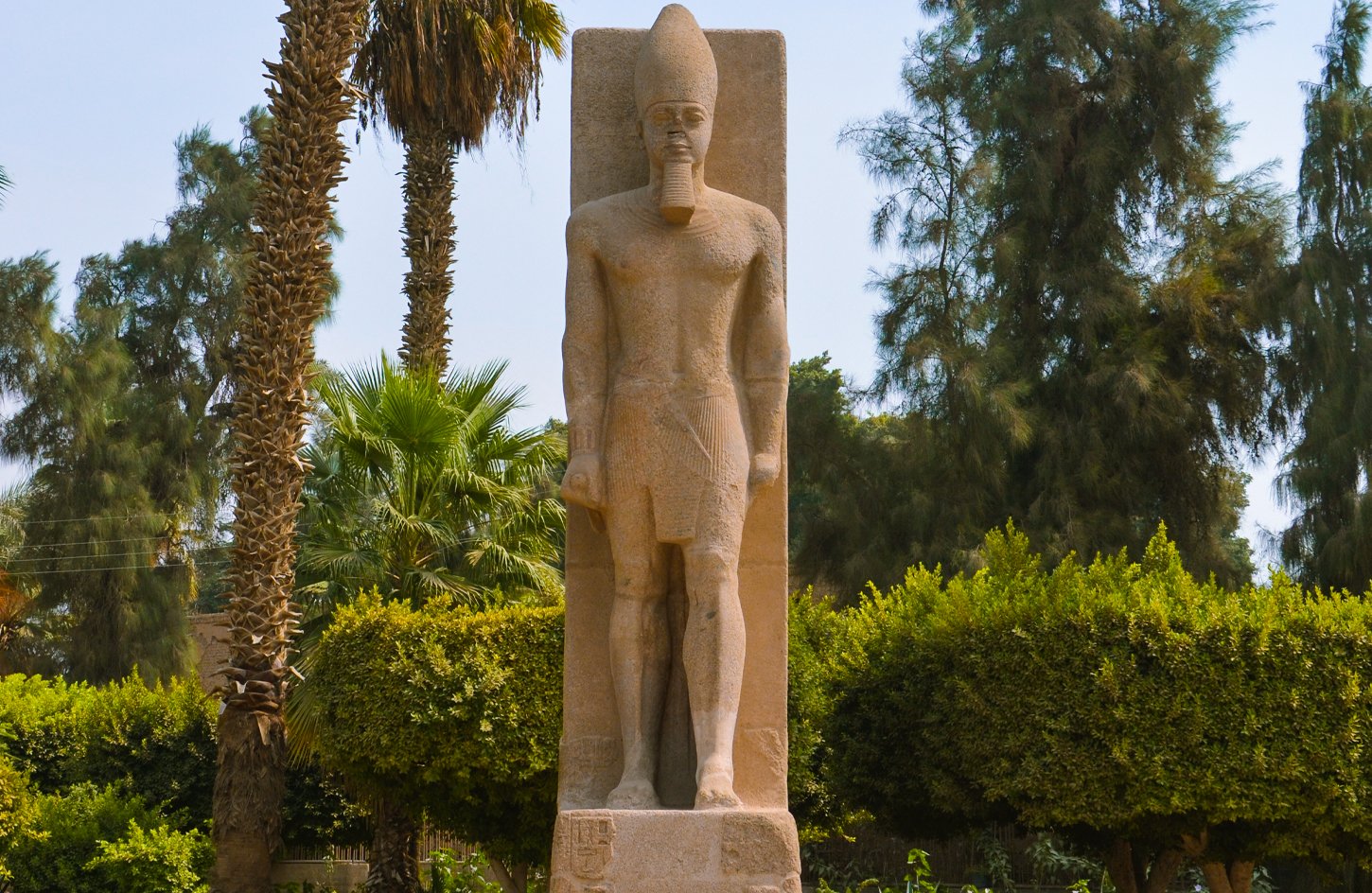
The Strategic Location of Egypt’s First Capital
To truly appreciate the grandeur of Memphis, we must first look at the geography of ancient Egypt. Around 3100 BCE, King Menes (often associated with Narmer) achieved something unprecedented: he united the two distinct lands of Upper Egypt (the southern river valley) and Lower Egypt (the northern delta).
To govern this newly unified kingdom effectively, Menes needed a seat of power that could bridge both regions. He chose a spot right at the apex of the Nile Delta, where the river fans out into the Mediterranean Sea. The strategic location of Egypt’s first capital allowed the pharaoh to control the crucial trade routes flowing up and down the Nile, as well as the overland routes to the Levant and the western oases.
The topographical features of the Nile Delta region played a massive role in the city’s success. The fertile floodplains provided abundant agricultural wealth, sustaining a booming population. Furthermore, the marshy, labyrinthine waterways of the delta provided a natural defense against northern invaders, while the narrow river valley to the south channeled all domestic trade directly through the capital’s toll gates.
Finding Memphis: Where is it on the Map?
If you are trying to find Memphis Egypt on map today, you will not see a towering metropolis. Over centuries, the shifting course of the Nile River, combined with the continuous recycling of ancient stone by later civilizations to build modern Cairo, slowly erased the grand cityscape.
When you pull up a modern Memphis Egypt map, you need to look about 20 kilometers (12 miles) south of central Cairo, on the west bank of the Nile. The ancient city lies beneath and around the modern agricultural village of Mit Rahina.
For archaeologists, identifying archaeological sites in Lower Egypt is notoriously difficult because the high water table and continuous agricultural use of the land obscure ancient ruins. Unlike the arid desert plateaus of Upper Egypt where temples stand perfectly preserved in the dry sand, Memphis old Egypt was built on the floodplain. Consequently, much of the original mudbrick city has dissolved back into the earth. However, what remains is nothing short of breathtaking. 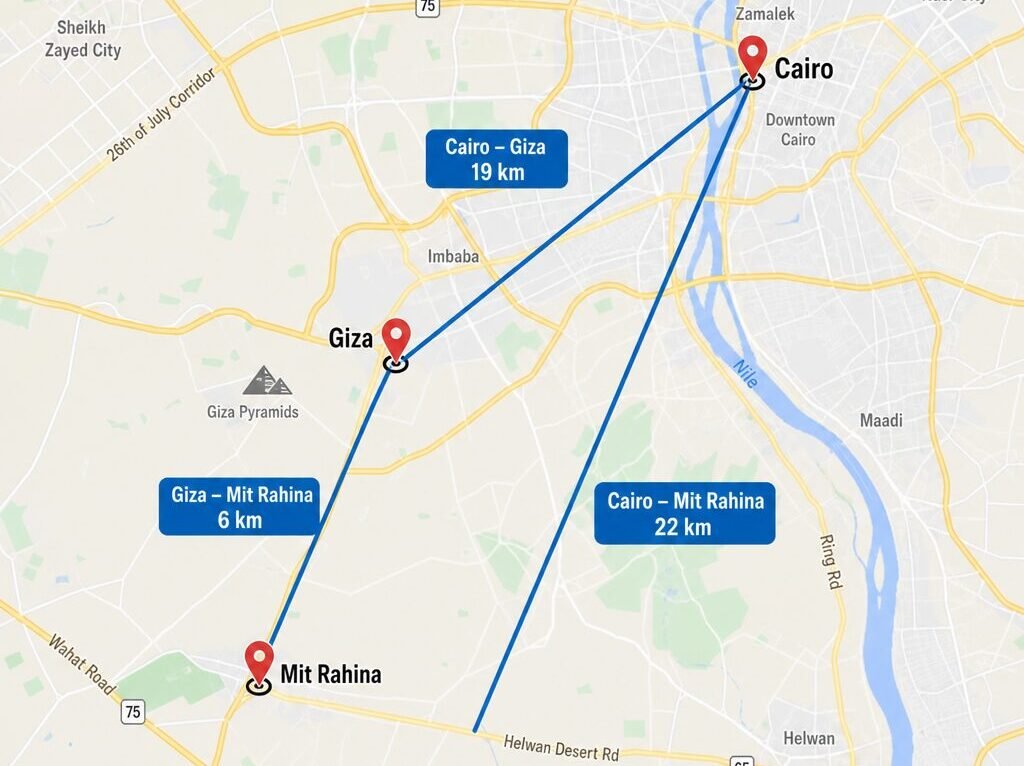
The Ancient Egyptian Capital City Layout
How did the earliest urban planners design a city fit for the gods and pharaohs? The ancient Egyptian capital city layout was vastly different from what we see in modern urban environments. When evaluating ancient city planning vs modern settlements, the most striking difference is the concept of permanence.
In modern cities, we build our residential homes, skyscrapers, and civic centers out of steel, concrete, and stone, expecting them to last indefinitely. In ancient Memphis, stone was strictly reserved for the eternal: the temples of the gods and the tombs of the dead. The city of the living—including the opulent palaces of the pharaohs, administrative buildings, and residential neighborhoods—was built entirely of sun-baked mudbrick. The Egyptians understood that human life was temporary, and therefore, the architecture of daily life reflected that impermanence.
Exploring Ruins of the White Wall City
Originally, Memphis was known as Ineb-hedj, which translates to “The White Walls.” This name likely referred to the fortified perimeter of the king’s palace, which was reportedly built of mudbrick and whitewashed with gleaming gypsum. Exploring ruins of the White Wall city today requires a vivid imagination, as those original walls have long since vanished.
However, archaeologists have determined that the city’s layout was highly organized. It was centered around massive temple complexes, with sprawling residential sectors, bustling river ports, and artisan workshops radiating outward. Memphis was a cosmopolitan hub, home to Egyptians, Nubians, Libyans, and later, Greeks and Persians. The city’s layout adapted over its 3,000-year lifespan, shifting eastward as the Nile River naturally migrated over the millennia.
The Significance of Memphis in the Old Kingdom
The significance of Memphis in the Old Kingdom (c. 2700–2200 BCE) cannot be overstated. During this period, often referred to as the “Age of the Pyramids,” Memphis was the undisputed political, economic, and religious center of the known world.
Memphis was intimately tied to Ptah, the patron god of craftsmen, architects, and creation. According to Memphite theology, Ptah created the world simply by imagining it in his heart and speaking it into existence with his tongue. Because Memphis was the home of Ptah, it naturally became the patron city of builders—a fitting association for the civilization that would go on to construct the pyramids.
Even when later dynasties moved the political capital to cities like Thebes (modern-day Luxor) or Alexandria, Memphis remained Egypt’s bustling commercial hub and secondary capital. Pharaohs returned to Memphis to be crowned, reinforcing their divine right to rule by connecting themselves to the ancient legacy of the city. 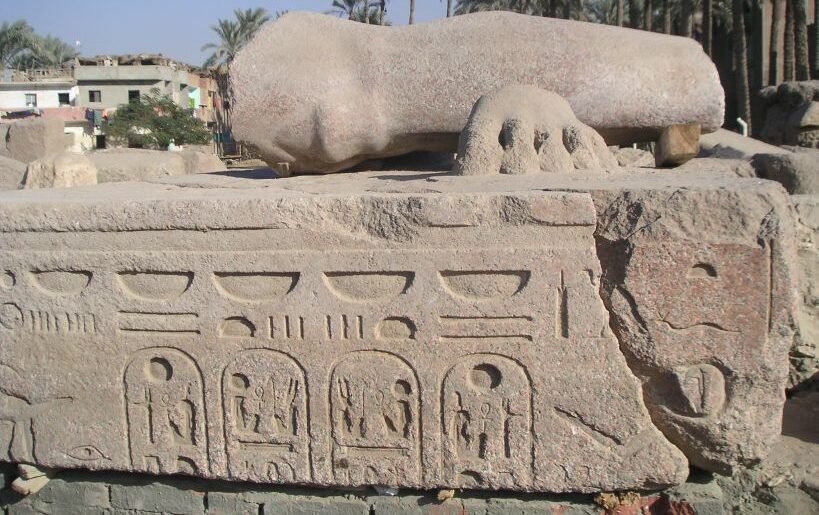
You cannot discuss Memphis without mentioning its sprawling cities of the dead. Because the living city was located on the lush, green floodplains, the ancient Egyptians looked to the arid western desert plateau to bury their dead. This massive burial ground stretches for over 30 kilometers along the desert edge.
Navigating the Necropolis of Memphis UNESCO site is an adventure through the evolution of ancient Egyptian architecture. This World Heritage site encompasses several iconic pyramid fields, including:
-
- Giza: Home to the Great Pyramids and the Sphinx.
-
- Saqqara: The primary necropolis for Memphis, featuring the Step Pyramid of Djoser (the oldest stone building complex in the world).
-
- Dahshur: Known for the Bent Pyramid and the Red Pyramid, where the true smooth-sided pyramid shape was perfected.
-
- Abusir: A site boasting Fifth Dynasty pyramids and intricate sun temples.
The wealth and power of Memphis Egypt are permanently etched into the desert skyline. These pyramids were not built in isolation; they were part of a massive administrative and logistical network managed directly from the capital city of Memphis.
The Mit Rahina Open Air Museum: What to See
Today, the physical remnants of the city are concentrated in a beautifully curated outdoor space. The Mit Rahina Open Air Museum location sits exactly where the heart of ancient Memphis once beat. Though small compared to the sprawling temples of Luxor, this museum houses some of the most impressive sculptural masterpieces of the ancient world.
Here are the absolute must-see highlights when you visit:
1. The Colossus of Ramses II
The undisputed star of Memphis is the massive limestone statue of Ramses the Great. Discovered in 1820 by Italian explorer Giovanni Battista Caviglia, this statue was originally part of a pair that flanked the eastern entrance of the great Temple of Ptah.
The Colossus of Ramses II statue dimensions are awe-inspiring. Even missing its lower legs, the sculpture measures over 10 meters (32 feet) in length and weighs approximately 83 tons. Today, it rests on its back inside a specially built two-story viewing pavilion. This allows visitors to walk around the statue on the ground floor and then ascend to a balcony to look down upon the pharaoh’s serene, flawlessly carved face. The level of detail—from the royal cartouches carved into his shoulders to the intricate dagger tucked into his belt—is a masterclass in ancient stone masonry. 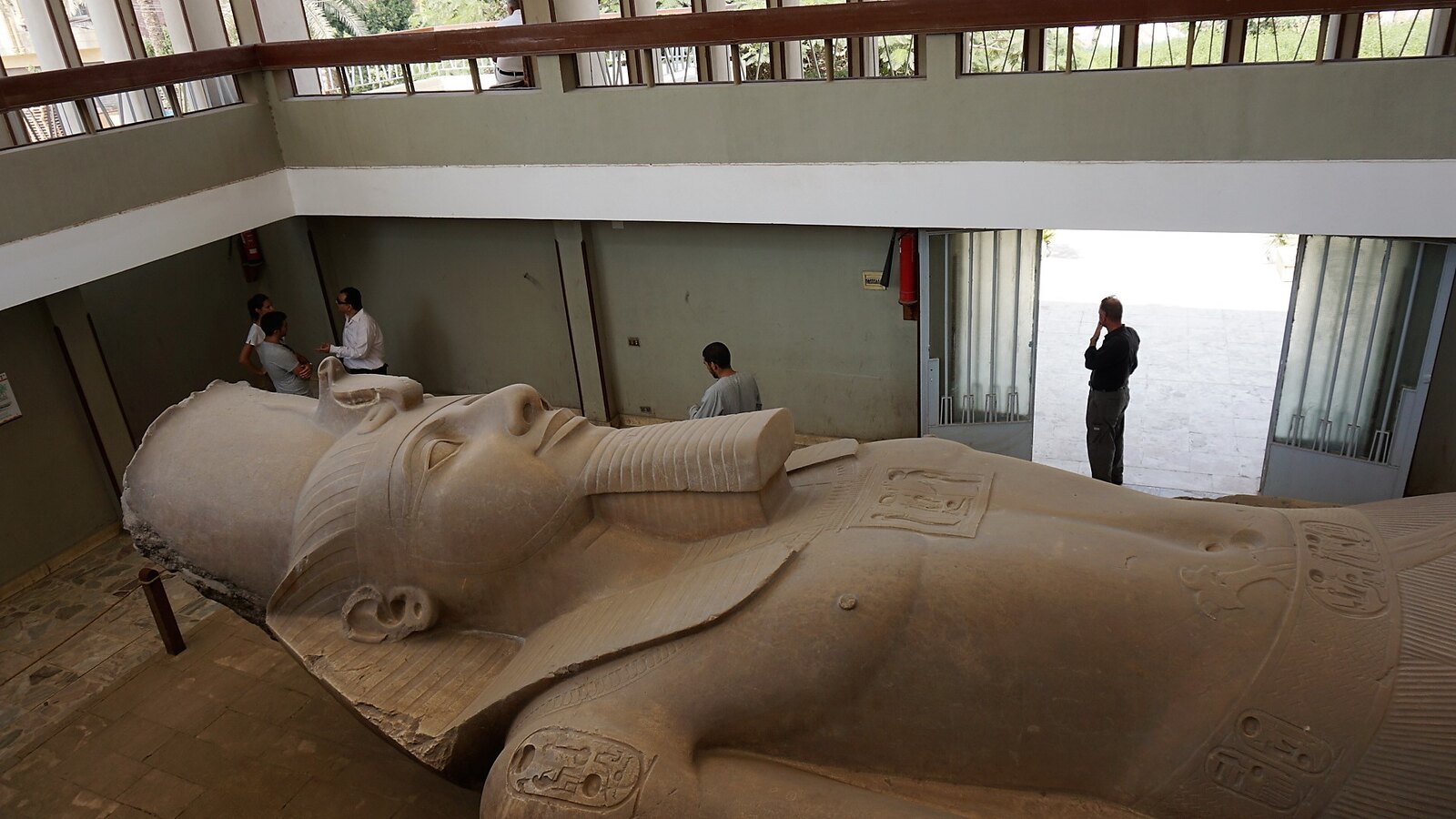
2. Locating the Great Sphinx of Memphis
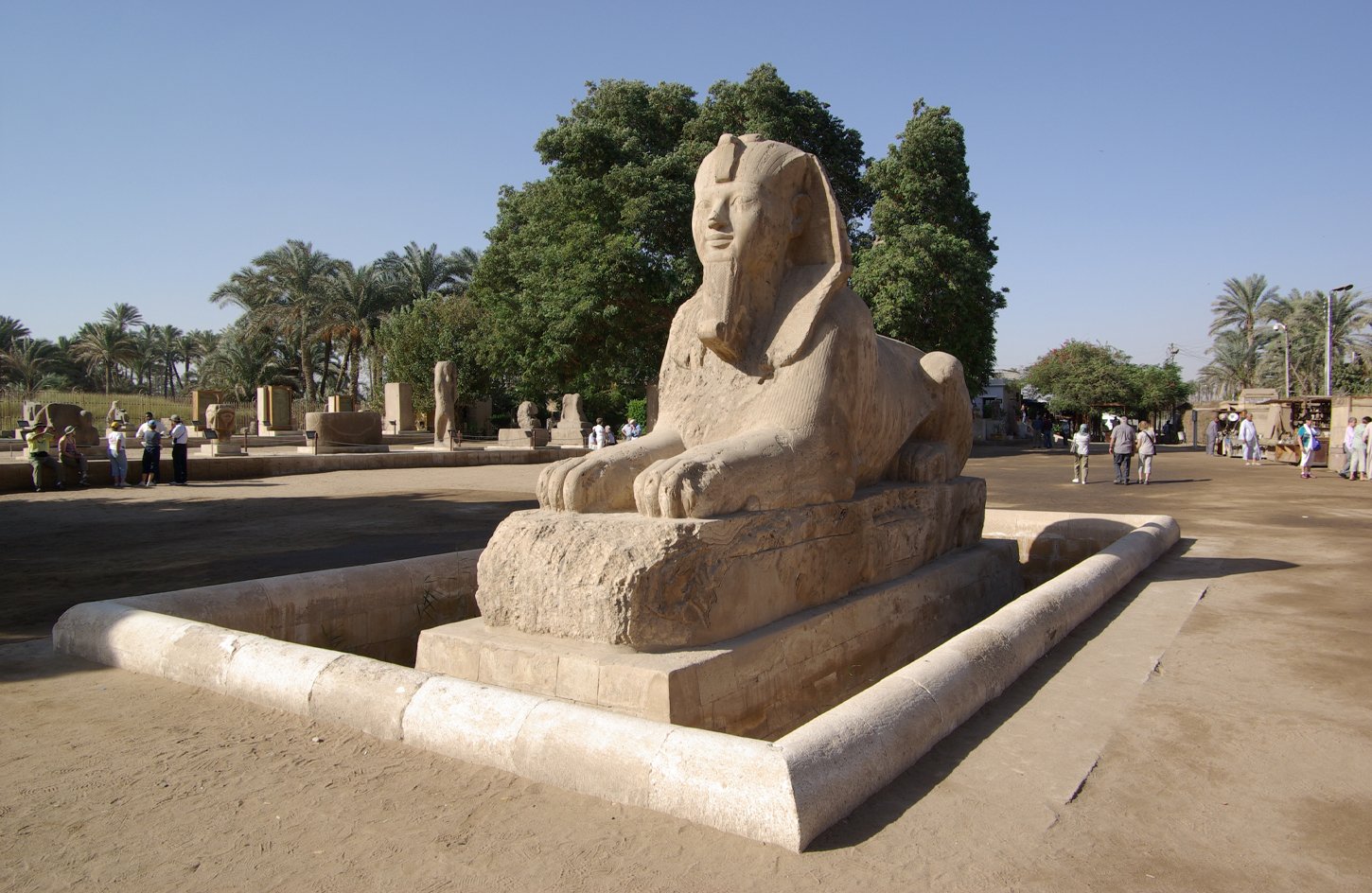
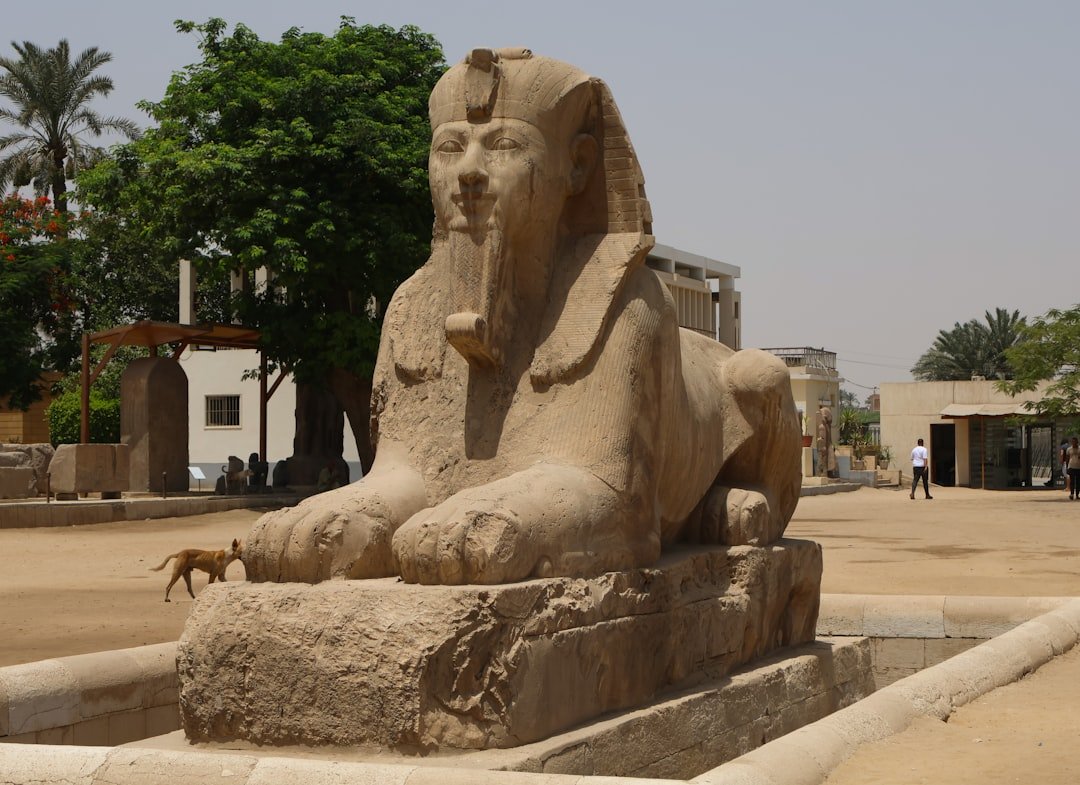
When most people hear the word “Sphinx,” they immediately think of Giza. However, locating the Great Sphinx of Memphis offers a uniquely rewarding experience. Situated proudly in the center of the open-air museum’s garden, this stunning monument is the largest artifact in the world carved entirely from a single piece of calcite (often referred to as Egyptian alabaster).
Weighing in at roughly 80 tons and standing 4 meters (13 feet) tall, the Alabaster Sphinx is believed to represent either Queen Hatshepsut or King Amenhotep II, dating back to the New Kingdom (around 1500 BCE). Unlike the Giza Sphinx, which has been heavily weathered by desert winds and sand, the Memphis Sphinx boasts relatively smooth features, having spent centuries safely buried beneath the protective mud of the Nile before its discovery in 1912.
3. Where is the Temple of Ptah?
A common question from history buffs visiting the site is, “Where is the Temple of Ptah?” In its prime, the Great Temple of Ptah (known as Hout-ka-Ptah, meaning “Enclosure of the Ka of Ptah”) was one of the largest and most important religious structures in all of Egypt, rivaling the Temple of Karnak in Thebes. In fact, the Greek mispronunciation of Hout-ka-Ptah (Aigyptos) is the etymological root of the modern word “Egypt.”
Today, the ruins of this once-great temple form the archaeological zone immediately surrounding the open-air museum. While the towering pylons and grand halls are mostly gone—their stones having been quarried to build the mosques and palaces of Islamic Cairo—you can still explore the scattered foundations, column bases, and minor shrines that dot the landscape of Mit Rahina. Strolling through these remnants offers a poignant reminder of the relentless march of time.
Practical Guide: Visiting Memphis Today
If you are planning to add Memphis to your Egyptian itinerary, you need actionable, up-to-date information. Visiting this historic site is quite straightforward, provided you understand the logistics.
How to Get to Memphis from Cairo
Getting to Memphis from central Cairo requires a bit of planning, as public transportation to the rural village of Mit Rahina is sparse and difficult for non-Arabic speakers to navigate.
-
- Private Taxi / Rideshare: You can hire an Uber or a private taxi from Cairo. The journey takes about 45 minutes to an hour, depending heavily on Cairo’s infamous traffic. Tip: If you use a rideshare, negotiate with the driver to wait for you, as finding a return ride from the rural museum can be very difficult.
-
- Hiring a Private Driver: This is often the most cost-effective and stress-free method. Your hotel can arrange a driver for a half-day or full-day rate.
-
- Guided Tours: There are countless Memphis tours Egypt operators based in Cairo. Booking a guided tour usually includes round-trip air-conditioned transportation, an Egyptologist guide, and entrance fees.
Distance Between Memphis and Giza Pyramids
When planning your route, it is highly recommended to combine your visit to Memphis with the nearby pyramid sites. The distance between Memphis and Giza pyramids is roughly 22 kilometers (about 14 miles) to the north. However, Memphis is much closer to Saqqara (only about 3 kilometers away).
Because of this geographic clustering, a standard tourist route travels southward from Giza, stopping at Saqqara, and then culminating in Memphis.
Memphis Tours Egypt: What to Expect
If you opt for a guided tour, you can expect a rich, educational experience. A high-quality Egyptologist will bring the sparse ruins to life, helping you visualize the ancient city planning vs modern settlements surrounding you.
When selecting Memphis tours Egypt, look for packages that offer:
-
- Small group or private options for a more personalized experience.
-
- Included entrance fees to the Mit Rahina Open Air Museum.
-
- A combined itinerary that includes Saqqara and Dahshur.
-
- Enough time allocated at the viewing pavilion of Ramses II to take photographs without feeling rushed.
The Ultimate Giza Necropolis, Saqqara, and Memphis Day Trip Itinerary
As you uncover the fascinating history of Memphis—the first capital of ancient Egypt—why not take the next step and experience these remarkable archaeological treasures in person? Our tour to Giza, Memphis, and Saqqara brings Egypt’s ancient past to life, taking you from the iconic pyramids of the Giza Necropolis to the open-air museum of Memphis and the vast Saqqara Necropolis, home to the world-famous Step Pyramid of Djoser.
Check out the Full Itinerary on Easy Transfer 24/7 to see how this carefully planned journey combines history and unforgettable sights into one extraordinary day of exploration through the heart of ancient Egypt.
Bringing the Map of Egypt Memphis to Life
Looking at a map of Egypt Memphis today reveals a landscape vastly changed by time, nature, and human development. What was once the shining, cosmopolitan center of the ancient world is now a tranquil village surrounded by date palms and agricultural fields.
Yet, the legacy of Memphis is indelible. It was here that Egypt was born as a unified nation. It was the strategic location of Egypt’s first capital that allowed a great civilization to flourish, directing the construction of the mighty pyramids that still watch over the desert today.
By visiting the Mit Rahina Open Air Museum, navigating the wider Necropolis of Memphis UNESCO site, and standing face-to-face with the towering Colossus of Ramses II, you are not just looking at old stones. You are walking in the footsteps of pharaohs, high priests, and master builders.
So, the next time you unfurl a Memphis Egypt map or plan a journey down the Nile, remember to look past the modern borders. Seek out the ruins of the White Wall city, pay your respects at the Temple of Ptah, and let the quiet, ancient majesty of Memphis capture your imagination forever.
Have you ever visited Memphis, or are you planning a trip soon? Save this guide for your travels, and let us know which ancient wonder you are most excited to see!
Q&A
Question: Where exactly is ancient Memphis located today?
Short answer: Look about 20 kilometers (12 miles) south of central Cairo on the west bank of the Nile, beneath and around the modern farming village of Mit Rahina. The visible city is largely gone—its mudbrick dissolved on the floodplain, the Nile shifted course, and later builders reused its stone—so archaeologists focus on the Mit Rahina Open Air Museum and the surrounding archaeological zone to pinpoint the heart of ancient Memphis.
Question: Why did Egypt’s earliest rulers choose Memphis as the first capital?
Short answer: Founded around the unification of Upper and Lower Egypt (c. 3100 BCE), Memphis sat at the apex of the Nile Delta, perfectly positioned to bridge both regions. From here, the pharaoh could control Nile traffic and overland routes to the Levant and western oases. Fertile floodplains supported a large population, while the marshy delta offered natural defenses and the narrow southern valley funneled domestic trade through the capital’s tolls.
Question: If most of the city has vanished, what can I still see in Memphis?
Short answer: Start at the Mit Rahina Open Air Museum, which showcases the colossal limestone statue of Ramses II (over 10 meters long, ~83 tons) in a two-story pavilion and the 80-ton Alabaster Sphinx (about 4 meters tall), likely from the New Kingdom. Around the museum lie the scattered remains of the Great Temple of Ptah (Hout-ka-Ptah)—whose Greek mispronunciation (Aigyptos) gave us the word “Egypt.” Beyond the town, the UNESCO-listed “Memphis and its Necropolis” spans the desert edge for over 30 km, including Giza, Saqqara (with Djoser’s Step Pyramid), Dahshur (Bent and Red Pyramids), and Abusir.
Question: What role did Memphis play in the Old Kingdom and Egyptian religion?
Short answer: In the Old Kingdom (c. 2700–2200 BCE), Memphis was the political, economic, and religious nerve center of Egypt. It was closely tied to Ptah, the patron god of craftsmen and creation, whose Memphite theology held that Ptah conceived the world in his heart and spoke it into being—apt for the civilization that built the pyramids. Even when capitals later shifted to places like Thebes or Alexandria, pharaohs were crowned at Memphis, and the city remained a bustling commercial hub.
Question: How do I plan a visit that combines Memphis with nearby pyramid sites?
Short answer: Because the sites cluster closely (Memphis–Giza ~22 km; Memphis–Saqqara ~3 km), a single day can cover Giza/Dahshur, Saqqara, and Memphis. A practical route is: depart Cairo early; explore Giza (view the great Pyramids of Giza, Sphinx, and the Valley Temple); continue to Saqqara (Step Pyramid of Djoser, Mastaba of Mereruka, Pyramid of Teti); stop for a rural lunch; finish at Mit Rahina to see Ramses II, the Alabaster Sphinx, and the Temple of Ptah remains. Reach Mit Rahina by private taxi/rideshare (arrange a return), a hired driver via your hotel, or a guided tour that includes transport, entrance fees, and an Egyptologist guide.